
How to Find the Source of Moisture in Your Home (Complete Guide)
By: John Ledford | Date Posted: July 11, 2026
Table of Contents
Updated July 2026
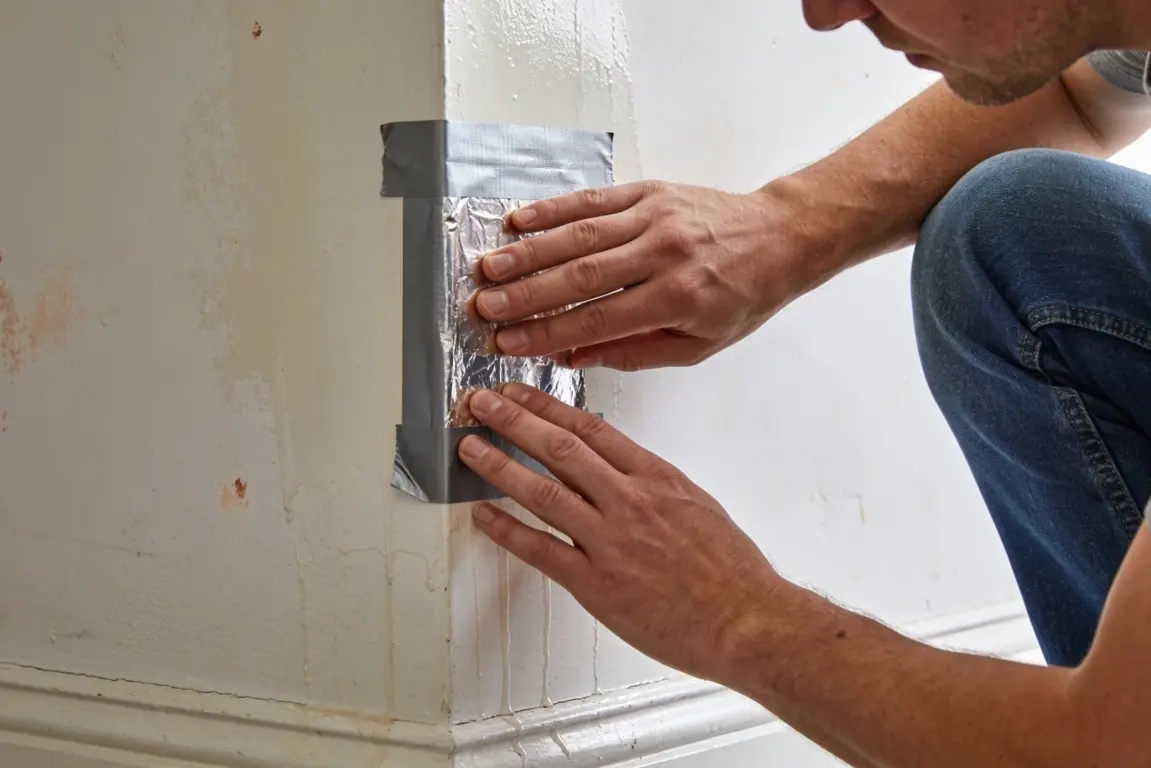
A damp patch, a musty smell, or a ring of mold on drywall usually comes from one of three places: condensation (moisture already in the air settling on a cold surface), a leak (water getting in from a pipe, roof, or window), or rising damp (groundwater moving up through a foundation wall). The fastest way to tell them apart is a 24-48 hour foil test on the damp spot. If moisture forms on top of the foil, it’s condensation. If it forms underneath, water is coming through the wall itself.
This is the diagnostic sequence I run before touching a repair. Fixing the wrong problem, like painting over a damp wall that’s actually a slow pipe leak, just buys you the same stain again in three months.
Condensation vs. a Leak vs. Rising Damp: How to Tell
| Sign | Condensation | Active Leak | Rising Damp |
|---|---|---|---|
| Location | Cold surfaces: window frames, exterior corners, bathroom ceiling | Localized, often below a pipe, appliance, or roof penetration | Bottom 3 ft of exterior/basement walls, floor-wall joint |
| Timing | Worse in cold weather, mornings, after showers/cooking | Appears after rain, or constant if it’s a supply line | Constant, slowly spreads, worse in wet seasons |
| Feel | Surface is damp, dries when heating/ventilation improves | Wet even in dry weather if the source is indoor plumbing | Damp with a tide-mark stain, sometimes white mineral deposits (efflorescence) |
| Smell | Musty only if it’s been going on for weeks | Musty plus sometimes a specific “wet drywall” smell | Earthy, persistent musty smell |
| Foil test | Moisture on top of foil | Moisture under foil, spot keeps growing | Moisture under foil, plus salt/mineral crust |
The Diagnostic Sequence
Step 1: Look at the pattern, not just the spot
Stand back and look at where the damp area sits relative to windows, pipes, the roofline, and grade level outside. A stain that starts at a ceiling corner near an exterior wall points to roof flashing or a gutter problem. A stain low on a basement wall points to grading or a foundation crack. A stain around a window points to failed caulking or condensation.
Step 2: Run the 24-48 hour foil test
Tape a 12×12 inch piece of aluminum foil tightly to the damp spot, sealed on all four edges with duct tape. Check it after 24 hours, then again at 48 hours.
- Moisture beads on the outside/room-facing side of the foil → it’s condensation. Ventilation or humidity is the fix, not a wall repair.
- Moisture appears underneath, against the wall → water is moving through the material itself. That’s a leak or rising damp, and the wall side needs the actual fix.
Step 3: Check with a moisture meter if you have one
A pin-type or pinless moisture meter gives you a number instead of a guess. As a general building-science range: wood and drywall under 15% moisture content is normal, 15-20% is worth watching, and readings above 20% put you in the range where mold and rot risk climbs. That 20% figure shows up as the standard threshold in moisture-meter guides from manufacturers like Delmhorst and Wagner, though exact cutoffs shift a little by material, so treat it as a general guide, not a lab spec. Take readings at several points moving away from the stain. A reading that drops off sharply a foot away usually means a localized leak; a reading that stays high across a whole wall section points to rising damp or a bigger water source.
Step 4: Trace it to a likely source
Once you know it’s not simple condensation, work outward from the spot. Most of the time the actual cause is something small and mechanical sitting nearby, not a hidden structural failure:
- Near a bathroom or kitchen wall: check supply lines, drain traps, and the wax ring under a toilet if the stain is on a ceiling below.
- Near an exterior wall or basement: check outside grading (should slope away from the house at least 6 inches over 10 feet), gutters and downspouts (should discharge at least 3-4 feet from the foundation), and any visible foundation cracks.
- Near a roofline: check flashing around chimneys, vent pipes, and skylights, and look for missing or lifted shingles above the stain.
- Around windows: check exterior caulking and weep holes; failed caulking lets wind-driven rain in, which looks like condensation but isn’t.
Common Sources by Location
Bathroom. Usually condensation from showers with no exhaust fan or a fan that’s not vented outside (some just dump into the attic, which causes its own mold problem). If the stain tracks to the floor below a toilet or tub, it’s plumbing, not condensation. Check our plumbing and HVAC guides if the source turns out to be a supply line or drain rather than airborne humidity.
Basement. Most often grading and gutters pushing water toward the foundation, or a foundation crack letting groundwater in after heavy rain. Rising damp shows up as that tide-mark stain along the bottom of the wall rather than a single spot. A basement is also the one place where a sump pump failure can masquerade as a moisture-source mystery: if the dampness only shows up after heavy rain and the house has a sump pit, check that the pump actually kicks on and the discharge line drains well away from the foundation before assuming it’s a wall or grading problem.
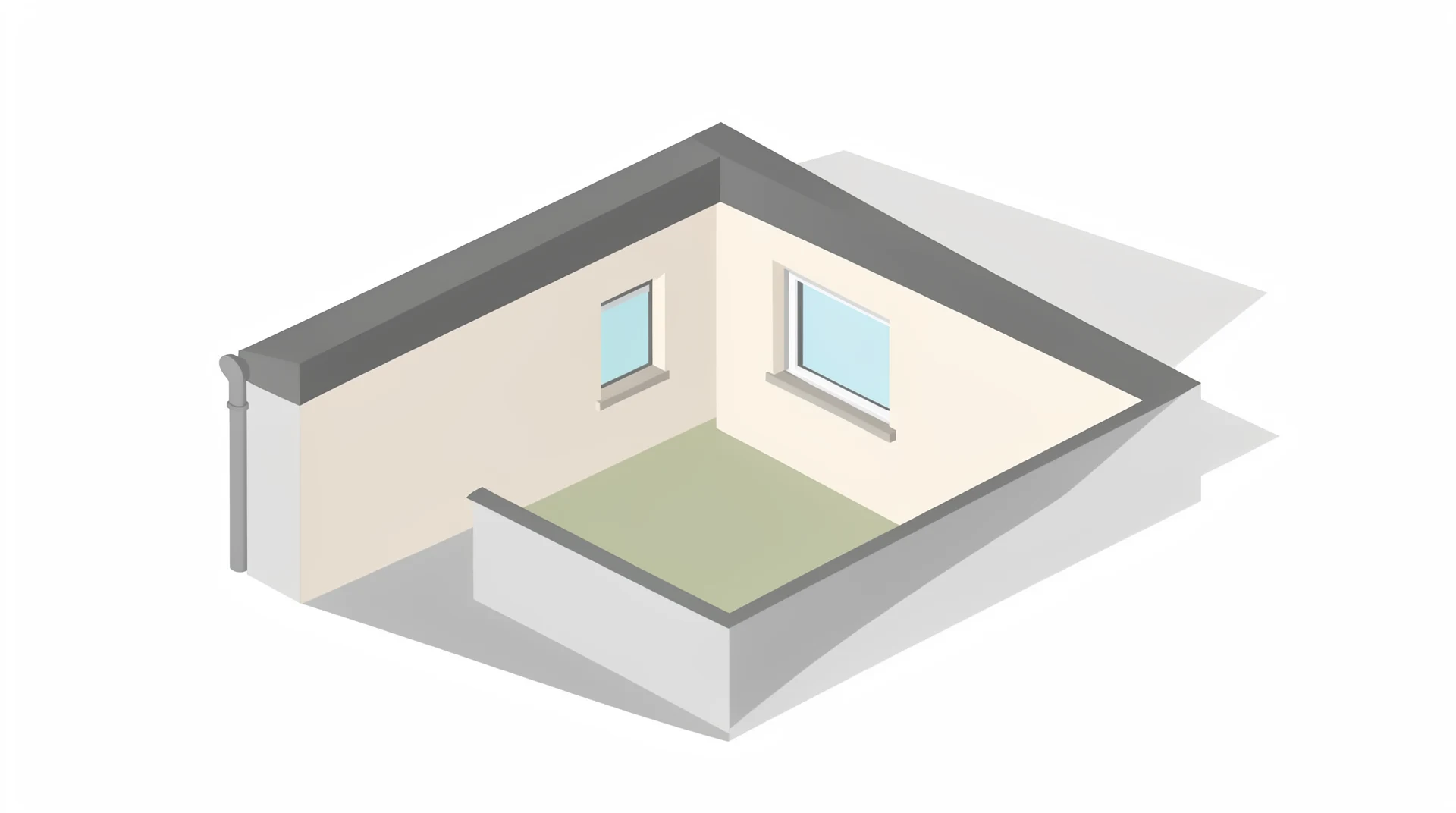
Exterior wall (upper floors). Look at what’s directly outside: a clogged gutter, a missing downspout extension, or siding that’s lost its caulking at a seam. This is the single most common source I run into, because a downspout extension is cheap and easy to knock loose (a lawnmower, a dog, wind) and homeowners rarely think to check it before assuming the wall itself has failed.
Ceiling / under the roof. Roof leaks travel, so a stain isn’t always directly below the actual hole. Check the attic side first, following the roof rafters upslope from the stain for wet insulation or dark streaks on the sheathing.
Windows. Condensation is the default explanation, and it usually is: single-pane or older double-pane windows in a humid house will fog every cold morning. But if the sill itself stays damp on dry, warm days, water is getting past the exterior seal.
Tools You’ll Need
- Aluminum foil and duct tape (for the foil test)
- A pin-type or pinless moisture meter ($20-$60 for a basic consumer model, $100+ for a more accurate pinless unit)
- A flashlight, for checking attic sheathing and behind furniture
- A flathead screwdriver, to gently probe wood that feels soft (soft, spongy wood under a painted surface is a sign of rot, not just surface dampness)
- A tape measure, for checking gutter discharge distance and grading slope
None of this is expensive. The foil test costs nothing beyond what’s already in a kitchen drawer, and a basic moisture meter is a one-time $30-40 purchase that pays for itself the first time it saves you from tearing into a wall that turns out to be dry.
What This Actually Costs to Fix
The diagnosis is free or nearly free. The fix depends entirely on what you find:
- Condensation fix: a bathroom exhaust fan upgrade runs $150-300 installed; a portable dehumidifier for a basement runs $180-300.
- Downspout/grading fix: a downspout extension is $10-15; regrading a section of yard yourself is a weekend of labor, or $300-800 if you hire it out.
- Caulking/sealing fix: a tube of exterior caulk and a caulking gun is under $20, plus an afternoon.
- Active leak (plumbing/roof): this is where costs jump. A plumber call-out for a leak diagnosis and fix typically runs $150-500 depending on access; a roof leak repair runs $300-1,500 depending on how much decking needs replacing.
- Foundation crack injection: $300-800 for a straightforward hairline crack; structural issues cost significantly more and need a structural engineer’s opinion first, not just a contractor’s quote.
The point of doing the diagnostic sequence first is that it tells you which of these categories you’re actually in, instead of guessing and paying for the wrong repair.
What I Found Doing This
I ran the foil test on a corner of my own basement that had a musty smell but no visible stain. Moisture showed up under the foil at 36 hours, not on top, so the dehumidifier-and-ventilation fix I expected wasn’t going to solve it. Tracing it outside, I found a downspout extension that had come loose and was dumping water right against the foundation instead of away from it. Re-securing the extension and adding a splash block solved the problem; the wall itself needed no repair at all. The interior stain was a symptom, and the actual source turned out to be something simple sitting right outside that wall.
The foil test failed me once, on a very slow, intermittent leak. Moisture showed up on both sides of the foil because the drywall had already become saturated over time. A moisture meter reading taken at increasing distances from the stain told me more than the foil test did in that case.
When It’s Just Condensation vs. When to Call a Professional
If the foil test shows moisture on top only, and readings drop to normal a short distance from the stain, this is a ventilation/humidity issue you can address yourself: run exhaust fans longer, add a dehumidifier, or improve air circulation.
Call a professional if:
- The foil test shows moisture underneath, meaning water is entering through the material.
- The stain keeps growing or returns within weeks of a fix you made.
- You find a foundation crack wider than a hairline, or the wall feels soft/spongy.
- There’s visible mold covering more than about 10 square feet (per EPA guidance on when to bring in remediation help).
- You can’t locate a source after checking the obvious ones above. A hidden plumbing leak inside a wall needs a leak-detection professional, not more guessing.
FAQ
How long does the foil test take?
Tape it down and check at 24 hours, then again at 48 hours if the first check is unclear. Don’t judge it before 24 hours; condensation needs a full day-night cycle to show a pattern.
Can a moisture problem be both condensation and a leak?
Yes. A slow leak raises humidity in a space, which then also causes secondary condensation nearby. If fixing ventilation doesn’t fully resolve the damp spot, go back and check for a leak source.
Why does the stain show up in a different spot than the actual leak?
Water follows gravity and the path of least resistance along framing, sheathing, and pipes before it soaks through in a visible spot. This is especially common with roof leaks, where water can travel several feet from the entry point before dripping through the ceiling.
Is a musty smell without a visible stain still worth investigating?
Yes. That was the case in my own basement, described above. Smell often shows up before a visible stain does, especially behind furniture or in less-ventilated corners.
Do moisture meters work through paint or wallpaper?
Pin-type meters can get a reading through most latex paint by pushing the pins in slightly; heavy wallpaper or multiple paint layers can skew results, so cross-check with the foil test if the reading looks unusual.
Does opening a window help while I’m testing?
No, and it can actually make the foil test less reliable. Opening a window changes the room’s humidity and air movement mid-test, which can make a condensation spot look drier than it really is or introduce fresh outdoor moisture on a humid day. Keep doors and windows in the room closed for the full 24-48 hours so the test reflects normal conditions, not whatever the weather happened to do that day.
Related: Why Does My House Smell Musty After Rain? (Causes & Fixes)
Part of our Moisture Control Guide.
Thank you for reading!