
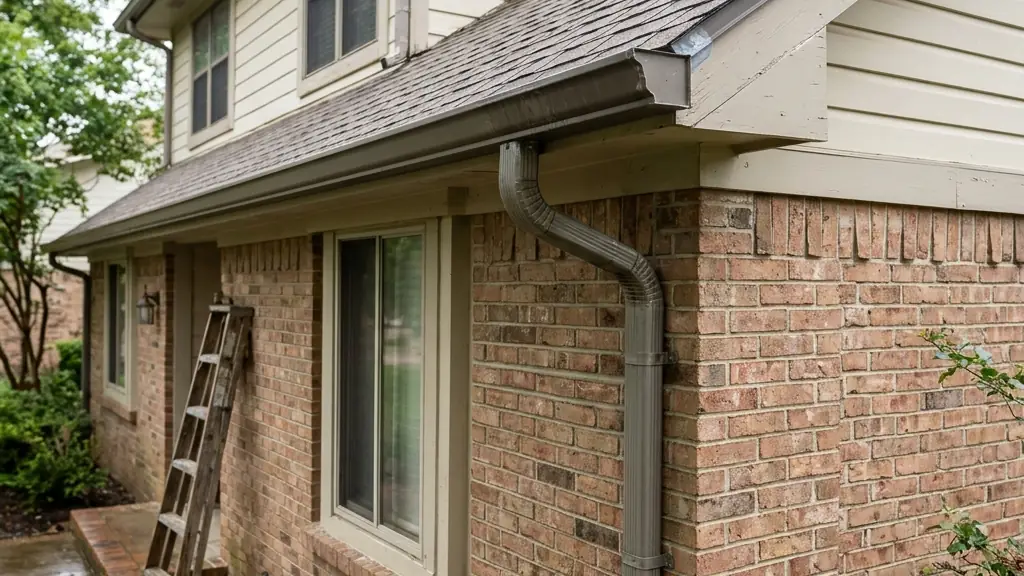
How to Fix a Leaky Gutter Yourself: Step by Step
By: John Ledford | Date Posted: November 10, 2026
Table of Contents
A leaking gutter is almost always a failed joint, a cracked section, or a downspout that has clogged and backed water up over the lip. A ladder, a scraper, silicone or EPDM patching tape, and a pair of gloves cover the work. The trick is to find the true source before you climb up, because water runs along the underside of the gutter and drips far from where it entered.
Find the source, work dry, and use the right material for the joint.
Why gutters leak in the first place
Gutters fail in a handful of predictable ways. The seam between two sections opens as the sealant ages and the metal moves with temperature. Hangers pull loose and the gutter sags, causing water to pool before it reaches the outlet. A downspout blocks with leaves and grit, and the water backs up over the front edge. On older steel gutters, rust eats a pinhole that grows into a split.
Rainfall intensity is what the whole system is sized for. Gutter capacity design assumes a rainfall intensity of 0.0208 litres per second per square metre of roof area, according to the engineering figures summarised on Wikipedia’s rain gutter page. When a gutter is undersized or partly blocked, that flow has nowhere to go but over the side.
The profile matters too. A K-style gutter has a flat back that sits tight to the fascia and a shaped front, while a half-round gutter relies on brackets and a different hanger pattern. If you are unsure which one you have, this comparison of K-style and half-round gutter profiles is a useful starting point before you buy parts.
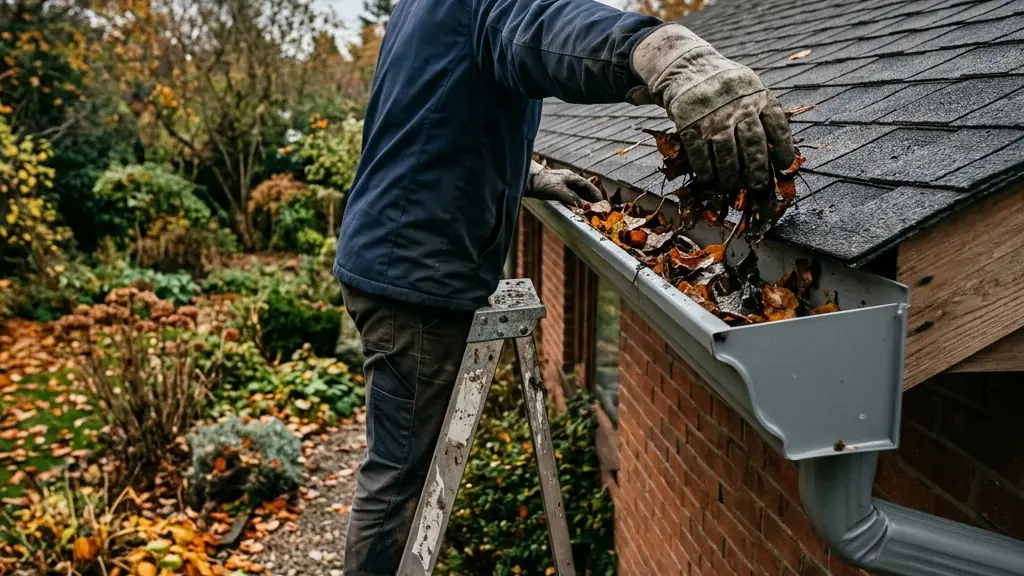
Tools and materials for a gutter repair
You do not need much. Most of this fits in a bucket you can hook onto the ladder.
- A stable ladder that reaches above the gutter line, with a stand-off if you can borrow one
- Work gloves and eye protection
- A stiff brush and a scraper or old chisel
- Silicone gutter sealant or a butyl-based sealant in a cartridge
- EPDM patching tape for splits and pinholes
- Self-tapping screws with a rubber washer, or rivets
- A cordless drill with a driver bit
- A small spirit level
- A bucket and a garden hose
For metal work, a pair of tin snips and a Torx or Phillips driver bit will cover most hanger and bracket screws. If your gutter is extruded aluminium, note that these can be formed on site in lengths of up to 30 m with internal brackets at 400 mm spacing, which is why a long seamless run has far fewer joints to fail than a short sectional one.
Buy sealant rated for outdoor use and for the metal you have. Silicone sticks well to aluminium and PVC. EPDM tape is the better choice for a split in the base of the channel, because it flexes with the metal instead of cracking.
Step by step: how to fix a leaky gutter
Work from the ground first. Look at where the drip lands, then trace it back up. Water often enters at a seam and runs along the underside of the gutter for a metre or more before it falls.
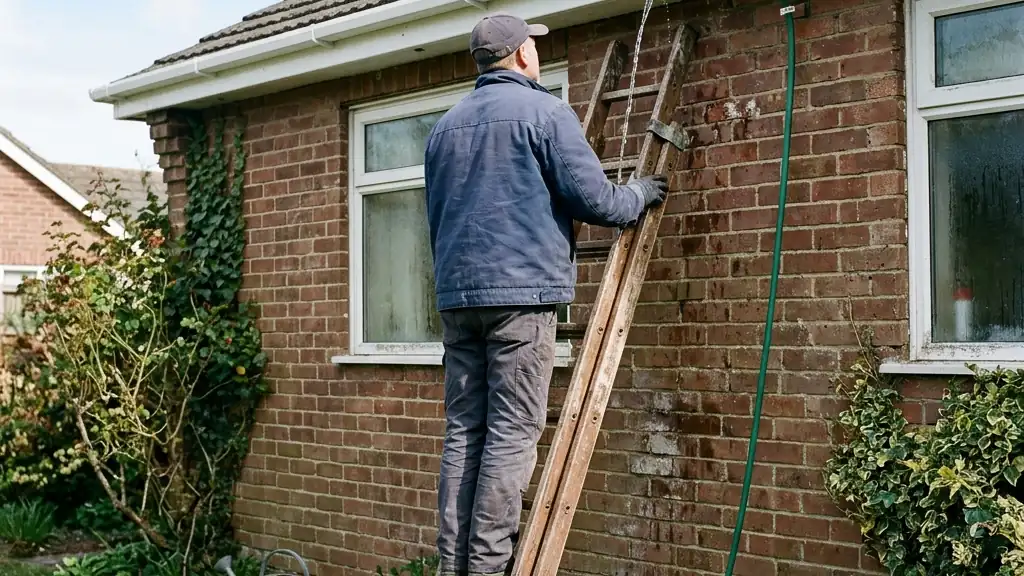
- Find the true source. Hose the roof above the suspect area while a helper watches from below. Mark the drip point with a pencil on the gutter face.
- Clear the channel and the downspout. Scoop out leaves and grit, then flush the outlet with a hose. If water backs up, the blockage is in the downspout, not the gutter.
- Scrub and dry the repair area. Wire-brush the seam or split until bare metal shows, then let it dry completely. Sealant will not bond to damp or dirty metal.
- Seal the joint or patch the split. Run a bead of sealant into the seam and press it in with a finger, or cut a length of EPDM tape and press it firmly over the split.
- Re-fix loose hangers and brackets. Replace missing screws, add a new hanger at the sag, and set the gutter to a slight fall toward the outlet.
- Test with water. Run the hose along the repaired section for a couple of minutes and watch from below for any trace of a drip.
- Check the downspout outlet at ground level. Make sure water discharges away from the foundation, not into a puddle against the wall.
Step by step: how to fix a leaky gutter1Find the true source2Clear the channel3Scrub and dry the repair area4Seal the joint or patch the split5Re-fix loose hangers6Test with water7Check the downspout outletThe steps from this section at a glance.
The drying step is the one people skip. Sealant will not bond to damp metal, so if the metal is cold and damp, wait for a dry morning.
Sealing a joint versus patching a split
A joint that has simply opened needs flexible sealant worked into the gap. Clean it back to bare metal, dry it, and press the bead in with a gloved finger so it fills the seam and bonds to the joint. A split or pinhole in the base of the channel is different. Sealant alone will crack as the metal expands in summer, so a self-adhesive EPDM patch that overlaps the split by a good margin holds up better.
Rust is the other case. A pinhole in a steel gutter will keep growing under a patch. If you can push a screwdriver through the metal around the hole, the section is finished and needs replacement.
If your gutters are open and you are thinking about covers, read up on whether gutter guards cause or prevent ice dams before you buy, because a guard that traps debris can make a blocked outlet worse in a cold snap.

When the problem is the downspout, not the gutter
A surprising number of “gutter leaks” are really blocked downspouts. Water fills the channel, finds the lowest point, and drips over the front edge. Clearing the outlet is part of the repair, and step 2 of the walkthrough above covers it.
Bird nests are a common culprit in spring, especially where the downspout has an open top. A bird guard gutter screen over the outlet stops nests forming in the downspout in the first place, and it is a cheap fix compared with replacing a rotted fascia board.
If the downspout runs underground, check the discharge end too. A collapsed or silted underground pipe backs water up the same way a nest does, and no amount of sealant on the gutter will stop the overflow.
When to call a pro
Call a professional when the work needs you above the first floor without safe footing, when the fascia behind the gutter is soft or stained, or when the gutter run has pulled away from the house along its whole length. Rot in the fascia is a carpentry job before it is a gutter job, and sealing over it just hides the problem.
Call someone too if the gutter is a long seamless aluminium run that has split at a bracket. Extruded aluminium formed on site in lengths of up to 30 m is not something you patch with a tube of silicone and expect to last. A specialist can re-form or replace the section.
And if you are not comfortable on a ladder at height, do not attempt the repair. Use safe footing or call a professional.
How rainfall and roof area affect your repair
It helps to understand why a small leak matters more than it looks. An indicative storm in Essex, with 500 mm annual rainfall, delivers 0.022 L/s/m², while one in Cumbria, with 1800 mm annual rainfall, delivers 0.014 L/s/m². The intensity is not simply proportional to annual rainfall, which is why a gutter sized for a dry region can still overflow in a short, heavy downpour.
The practical point is that a partly blocked or sagging gutter has less spare capacity than the design figures assume. Fixing the leak without restoring the fall and clearing the outlet just moves the overflow somewhere else.
How to Fix a Leaking Gutter FAQ
Can I seal a gutter leak from the ground?
No, sealant has to be worked into a clean, dry joint by hand, so you need to reach the gutter safely from a ladder or platform. Hose testing from the ground is useful for finding the drip, but the repair itself happens at the gutter.
What is the best sealant for a leaking gutter joint?
Silicone or butyl-based gutter sealant works well on aluminium and PVC joints, and EPDM patching tape suits splits in the base of the channel. Match the product to your gutter material and check the label for outdoor metal use.
Why does my gutter leak at the same seam every year?
The seam keeps opening because the gutter is moving, usually from a loose hanger or a missing bracket nearby. Re-fix the hanger and restore the fall toward the outlet before you reseal, or the joint will crack again.
Can a leaking gutter damage my house?
Yes, water running down the wall and pooling at the base soaks the fascia, stains masonry and can reach the foundation. Fixing a small leak early is far cheaper than replacing rotted fascia or repointing brickwork later.
Thank you for reading!