
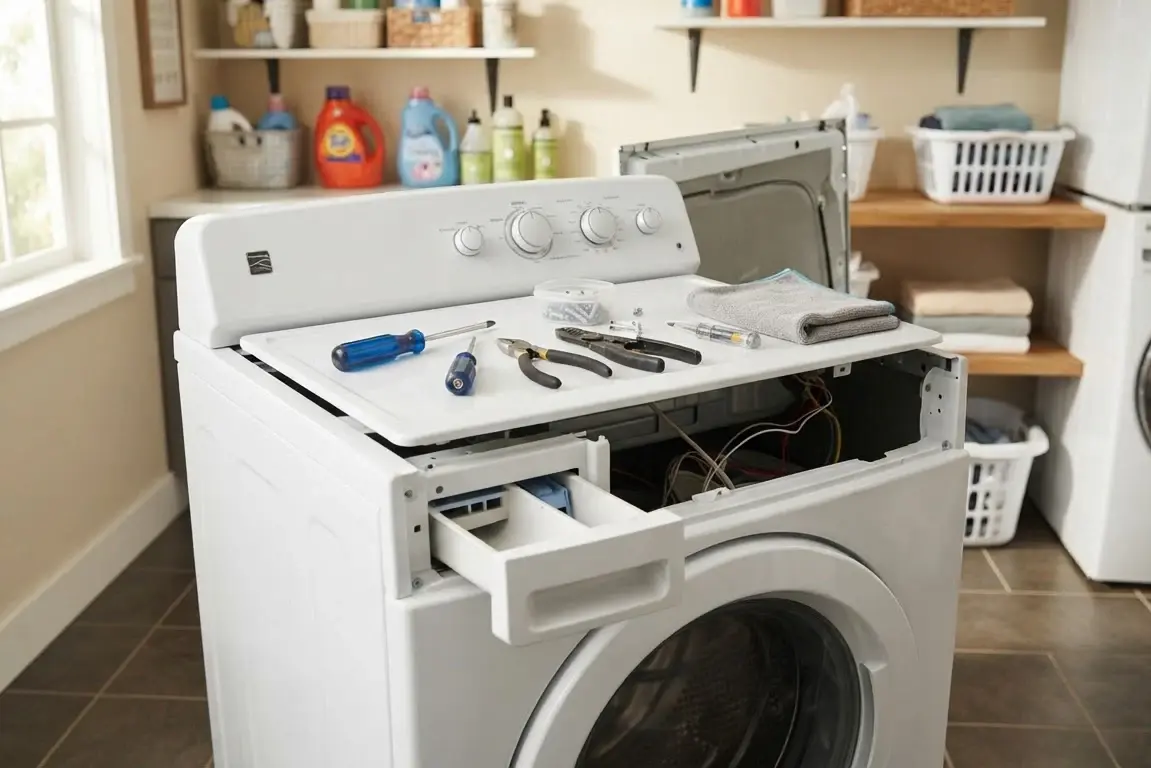
How To Easily Fix Your Washing Machine For Free (2026 Guide)
By: John Ledford | Date Posted: July 10, 2026
Table of Contents
- Washing Machine Won’t Start
- Washing Machine Won’t Drain
- Washing Machine Won’t Spin
- Washing Machine Is Leaking
- Frequently Asked Questions[+]
- How to Clean the Washing Machine Drain Pump Filter
- How to Check and Replace the Washing Machine Drive Belt
- How to Check and Replace the Water Inlet Valve
- Preventive Washing Machine Maintenance
- My Recommendation for Washing Machine Repair
- Common Washing Machine Noises and What They Mean
- When to Replace vs Repair Your Washing Machine[+]
Updated July 2026. Fixing a washing machine yourself can save you hundreds of dollars in repair costs. The most common problems are a machine that won’t start, won’t drain, won’t spin, or is leaking. Most of these problems can be diagnosed and fixed in under an hour with basic tools. I’ve repaired washing machines in several homes, and the process is usually straightforward.
Below I’ll explain the most common washing machine problems and how to fix them.
Washing Machine Won’t Start
If your washing machine won’t start, check the power supply first. Make sure the machine is plugged in and the circuit breaker hasn’t tripped. Check the door latch. Most washing machines won’t start if the door isn’t fully closed and latched. Clean the door latch mechanism and make sure it’s engaging properly. Check the control board. If the machine has power but won’t start, the control board may be faulty. This is a more complex repair that may require professional service. Check the timer or electronic control. If the machine has a mechanical timer, the timer may be faulty. If the machine has an electronic control, try resetting it by unplugging the machine for 5 minutes and plugging it back in.
Washing Machine Won’t Drain
If your washing machine won’t drain, the most common cause is a clogged drain pump filter. The filter is located at the bottom front of the machine, behind a small access panel. Open the access panel and remove the filter. Clean the filter under running water and remove any debris. Check the drain hose for kinks or clogs. The drain hose may be clogged with lint or debris. Disconnect the hose and clean it out. Check the drain pump. If the pump is clogged or faulty, it may need to be cleaned or replaced. The pump is located at the bottom of the machine, behind the access panel. Listen for a humming sound when the machine tries to drain. If you hear humming but the water isn’t draining, the pump may be clogged. If you don’t hear anything, the pump may be faulty.
Washing Machine Won’t Spin
If your washing machine won’t spin, the most common cause is an unbalanced load. Open the door and redistribute the clothes evenly in the drum. If the machine is still unbalanced, try removing some items and running the spin cycle again. Check the lid switch. Most washing machines won’t spin if the lid isn’t fully closed. The lid switch may be faulty and need to be replaced. Check the drive belt. If the belt is broken or loose, the drum won’t spin. The belt is located at the back of the machine. If the belt is broken, replace it. If the belt is loose, tighten it. Check the motor coupling. The motor coupling connects the motor to the transmission. If the coupling is broken, the motor will run but the drum won’t spin. The coupling is located at the back of the machine, behind the access panel. Replace the coupling if it’s broken.
Washing Machine Is Leaking
If your washing machine is leaking, the most common cause is a loose or damaged hose connection. Check the water supply hoses at the back of the machine. Tighten the connections if they’re loose. Check the hoses for cracks or damage. Replace damaged hoses. Check the drain hose connection. The drain hose may be loose or damaged. Check the door seal. The rubber gasket around the door may be worn or damaged. Clean the seal and check for cracks. If the seal is damaged, replace it. Check the detergent dispenser. The dispenser may be clogged or damaged, causing water to leak from the front of the machine. Clean the dispenser and check for damage. Check the tub seal. The seal between the inner and outer tub may be worn or damaged. This is a more complex repair that may require professional service.
Frequently Asked Questions
Is it worth fixing a washing machine?
It depends on the age of the machine and the cost of the repair. If the machine is less than 5 years old, it’s usually worth fixing. If the machine is more than 10 years old, consider replacing it.
Can I fix a washing machine myself?
Many common washing machine problems can be fixed yourself with basic tools. Simple repairs like cleaning the drain pump filter or replacing a hose are DIY-friendly. More complex repairs may require professional service.
How much does it cost to repair a washing machine?
A professional washing machine repair costs about $100 to $300 for common problems. Major repairs like replacing the motor or control board can cost $200 to $500. DIY repairs cost $10 to $50 for parts.
How long does a washing machine last?
A typical washing machine lasts 10 to 14 years. Regular maintenance can extend the life of the machine. If your machine is more than 10 years old and has a major problem, consider replacing it.
Written by Mike, home improvement and appliance repair specialist. Updated July 2026.
How to Clean the Washing Machine Drain Pump Filter
The drain pump filter traps lint, coins, and other debris that can clog the drain pump. Cleaning the filter is the most common washing machine repair and can fix many drainage problems. The filter is located at the bottom front of the machine, behind a small access panel. Open the access panel. You may need a screwdriver to remove the panel. Place a towel or shallow pan under the filter to catch any water that may spill out. Turn the filter counterclockwise to remove it. Clean the filter under running water. Remove any debris, lint, or foreign objects. Check the filter housing for debris. Remove any debris from the housing. Install the filter and turn it clockwise to secure it. Close the access panel. Run a test cycle to make sure the machine is draining properly. If the machine still doesn’t drain, the drain pump may be faulty and need to be replaced. The drain pump is located behind the access panel, next to the filter. The pump is usually secured with screws or clips. Remove the pump and install a new one. The cost of a new drain pump is about $20 to $50.
How to Check and Replace the Washing Machine Drive Belt
The drive belt connects the motor to the drum and allows the drum to rotate. If the belt is broken or loose, the drum won’t spin. To check the belt, unplug the machine and remove the back access panel. The belt is located at the back of the machine, connecting the motor pulley to the drum pulley. Check the belt for cracks, fraying, or looseness. If the belt is damaged, it needs to be replaced. To replace the belt, purchase a replacement belt that is compatible with your machine model. Remove the old belt by sliding it off the pulleys. Install the new belt by sliding it onto the drum pulley first, then onto the motor pulley. Make sure the belt is properly aligned on both pulleys. Check the belt tension. The belt should be tight enough that it doesn’t slip but not so tight that it strains the motor. Replace the back access panel. Plug the machine back in and test it. The cost of a new drive belt is about $10 to $20.
How to Check and Replace the Water Inlet Valve
The water inlet valve controls the flow of water into the washing machine. If the valve is faulty, the machine may not fill with water or may fill slowly. To check the valve, unplug the machine and turn off the water supply. Remove the top panel of the machine. The valve is located at the back of the machine, where the water supply hoses connect. Check the valve for visible damage or corrosion. Use a multimeter to test the valve for continuity. If the valve does not have continuity, it needs to be replaced. To replace the valve, disconnect the water supply hoses from the valve. Disconnect the wire harness from the valve. Remove the mounting screws that hold the valve in place. Install the new valve and secure it with the mounting screws. Connect the wire harness to the new valve. Connect the water supply hoses to the new valve. Turn on the water supply and check for leaks. Replace the top panel. Plug the machine back in and test it. The cost of a new water inlet valve is about $20 to $40.
Preventive Washing Machine Maintenance
Regular maintenance can extend the life of your washing machine and prevent problems. Clean the drain pump filter every 3 to 6 months. Leave the door open after each use to allow the interior to dry and prevent mold growth. Clean the door seal regularly with a damp cloth. Run a cleaning cycle with washing machine cleaner every 3 months. Use the correct amount of detergent. Too much detergent can cause excessive sudsing and damage the machine. Check the water supply hoses annually for cracks or bulges. Replace them if they show signs of wear. Level the machine if it vibrates excessively during the spin cycle. Clean the exterior of the machine regularly. Check the drain hose for kinks or damage. Following these preventive maintenance tips can extend the life of your washing machine and prevent costly repairs.
My Recommendation for Washing Machine Repair
Based on my experience with appliance repairs, I recommend starting with the simplest fix when your washing machine has a problem. Clean the drain pump filter first, as this solves many common problems. If the filter is clean and the problem persists, move on to more complex diagnostics. If you’re not comfortable working on the machine yourself, call a professional appliance repair technician. The cost of a service call is about $100 to $200, which is reasonable for a repair that can extend the life of your machine. If your machine is more than 10 years old and has a major problem, consider replacing it instead of repairing it. A new energy-efficient washing machine costs $500 to $1,200 and will save you money on utility bills over time.
Common Washing Machine Noises and What They Mean
Banging or thumping during the spin cycle is usually caused by an unbalanced load. Open the door and redistribute the clothes evenly. If the noise continues, the machine may be unlevel. Adjust the leveling feet to stabilize the machine. Squealing or screeching during the spin cycle is usually caused by a worn drum bearing or a faulty belt. The drum bearing is located at the back of the drum. If the bearing is worn, it needs to be replaced. This is a complex repair that may require professional service. The belt may be slipping or worn. Check the belt and replace it if necessary. Grinding during the spin cycle is usually caused by a faulty motor coupling or a worn transmission. The motor coupling connects the motor to the transmission. If the coupling is worn, replace it. The transmission is a complex component that requires professional service. Clicking or tapping during the cycle is usually normal. The machine’s timer or control board may be making clicking sounds as it cycles through the program. If the clicking is accompanied by a problem, such as the machine not filling or draining, the control board may be faulty. Humming when the machine is not running is usually caused by a faulty water inlet valve. The valve may be partially open, allowing water to trickle into the machine. Replace the valve if it’s faulty.
When to Replace vs Repair Your Washing Machine
Deciding whether to replace or repair your washing machine depends on several factors. The age of the machine is the most important factor. If the machine is less than 5 years old, it’s usually worth repairing. If the machine is more than 10 years old, consider replacing it. The cost of the repair is another factor. If the repair costs more than 50 percent of the cost of a new machine, replace the machine. The availability of parts is another consideration. If parts for your machine are difficult to find, replace the machine. The energy efficiency of your current machine is another factor. Newer machines are more energy-efficient and can save you money on utility bills. The frequency of repairs is also important. If you’re repairing the machine frequently, it’s time to replace it. A new washing machine costs $500 to $1,200. A professional repair costs $100 to $300. If you’re facing a major repair like a new motor or control board, the cost may be $200 to $500, which is close to the cost of a new budget machine.
Thank you for reading!