
What Is The Difference Between 220 And 240 Volt Outlets? (2026 Guide)
By: John Ledford | Date Posted: July 10, 2026
Table of Contents
- The Historical Difference
- What the NEC Says
- Why 220V and 240V Are Used Interchangeably
- Frequently Asked Questions[+]
- How 220V and 240V Circuits Work
- Identifying 220V and 240V Outlets
- Safety Considerations
- Common 220V and 240V Appliances
- My Recommendation
- How to Test a 220V or 240V Outlet
- Converting 120V to 240V
- Understanding Voltage Drop in 220V and 240V Circuits[+]
Updated July 2026. For practical purposes, 220V and 240V are the same thing. The difference is mainly historical and regional. In the United States, the standard household voltage is 240V, but it’s often referred to as 220V. This article explains the difference between 220V and 240V, why both terms are used, and what you need to know when dealing with electrical appliances.
Both 220V and 240V refer to the same type of electrical service: a double-pole circuit that provides power to large appliances like dryers, ranges, air conditioners, and EV chargers. The voltage difference is within the normal range of variation for the electrical grid.
The Historical Difference
The difference between 220V and 240V is a historical artifact. When the electrical grid was first developed in the late 1800s and early 1900s, different companies used different voltages. Some used 110V, others used 115V, and still others used 120V for standard household circuits. The same variation occurred for the higher voltage circuits. Some areas used 220V, others used 230V, and still others used 240V. Over time, the standard in the United States settled on 120V for standard household circuits and 240V for large appliances. However, the terms 220V and 240V are still used interchangeably by many people. The actual voltage delivered to your home can vary depending on the distance from the transformer and the load on the grid. The voltage can range from 220V to 240V and still be within the normal range.
What the NEC Says
The National Electrical Code provides specifications for electrical systems. The NEC specifies a nominal voltage of 120V for standard household circuits and 240V for large appliance circuits. The actual voltage can vary by plus or minus 5 percent from the nominal voltage. This means the actual voltage can range from 114V to 126V for a 120V circuit and from 228V to 252V for a 240V circuit. The NEC also specifies the voltage drop allowed for circuits. The voltage drop from the panel to the outlet should not exceed 3 percent for a branch circuit. This means the voltage at the outlet can be slightly lower than the voltage at the panel. The NEC requirements ensure that electrical equipment operates safely and efficiently. Equipment designed for 220V will work on a 240V circuit and vice versa, as long as the voltage is within the acceptable range.
Why 220V and 240V Are Used Interchangeably
The terms 220V and 240V are used interchangeably for several reasons. Many people use the term 220V because it was the standard in the past. The term 220V is still used in many older publications and by people who learned the trade years ago. The actual voltage can vary depending on the location and the load on the grid. A circuit that is nominally 240V may actually measure 220V under load. This is normal and within the acceptable range. Most electrical equipment is designed to operate over a range of voltages. A typical appliance is designed to operate at 220 to 240V. The appliance will work correctly at any voltage within this range. The terms 220V and 240V are used interchangeably in the electrical industry. Most electricians and contractors will understand what you mean regardless of which term you use.
Frequently Asked Questions
Is 220V the same as 240V?
Yes, for practical purposes, 220V and 240V are the same. Both terms refer to a double-pole circuit that provides power to large appliances. The voltage difference is within the normal range of variation.
Can I plug a 220V appliance into a 240V outlet?
Yes, a 220V appliance can be plugged into a 240V outlet. The appliance is designed to operate over a range of voltages. The voltage difference is within the normal range and will not damage the appliance.
What appliances use 220V or 240V?
Large appliances like electric dryers, electric ranges, air conditioners, water heaters, and EV chargers use 220V or 240V circuits. These appliances require more power than a standard 120V circuit can provide.
Do I need a special outlet for 220V or 240V?
Yes, 220V and 240V appliances require a special outlet that is designed for the higher voltage. The outlet is typically a NEMA 6-20, 6-30, 6-50, 14-30, or 14-50, depending on the appliance.
Written by Mike, home improvement and electrical specialist. Updated July 2026.
How 220V and 240V Circuits Work
A 220V or 240V circuit uses two hot wires instead of one. Each hot wire carries 120V relative to neutral. The voltage between the two hot wires is 240V. This is called a double-pole circuit because it uses a double-pole breaker in the panel. The double-pole breaker has two switches that are connected together so they trip at the same time. The circuit also includes a ground wire for safety. The neutral wire is optional for some appliances but required for others. A 220V or 240V circuit can provide more power than a standard 120V circuit because the voltage is higher. The power is calculated by multiplying the voltage by the current. A 240V circuit at 30 amps can provide 7,200 watts of power, while a 120V circuit at 15 amps can provide only 1,800 watts. The higher voltage also means that the current is lower for the same amount of power. Lower current means less heat in the wires and less voltage drop. This is why 240V circuits are used for large appliances that require a lot of power.
Identifying 220V and 240V Outlets
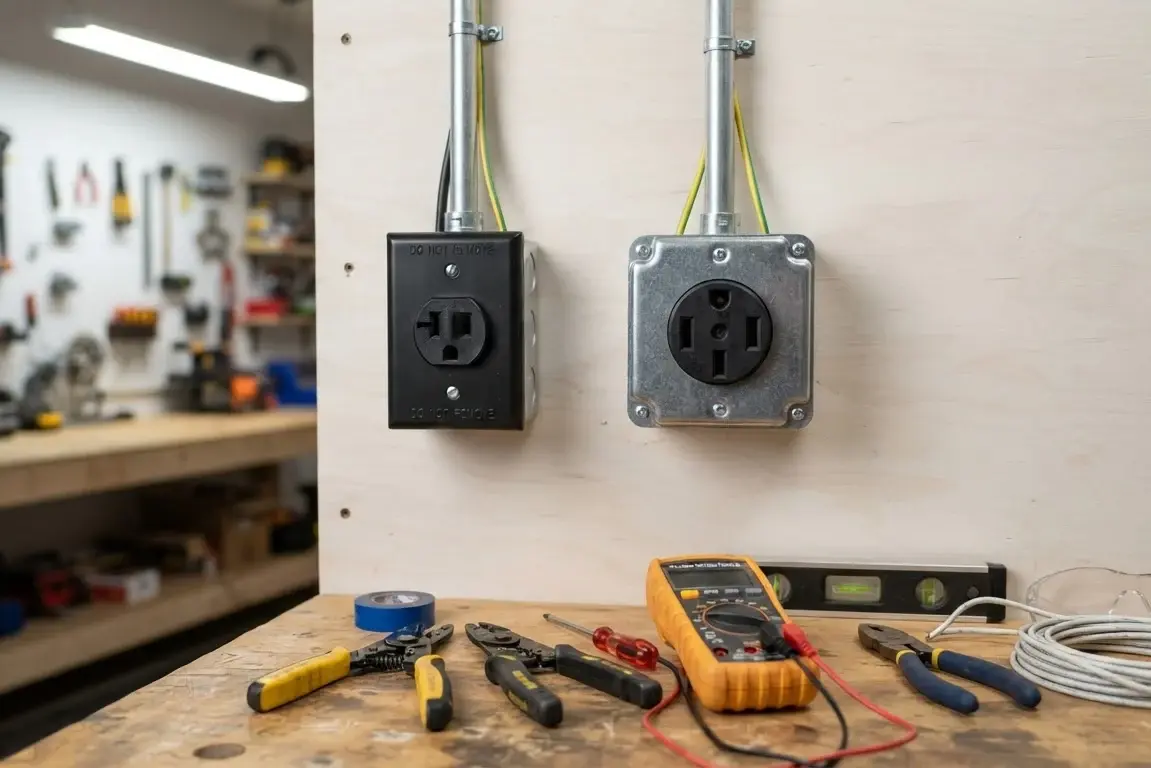
220V and 240V outlets look different from standard 120V outlets. The most obvious difference is the shape of the outlet. 220V and 240V outlets have slots that are shaped differently than 120V outlets. The outlet may have three or four slots, depending on the type. The outlet is typically larger than a standard 120V outlet. The outlet may be labeled with the voltage and amperage rating. The outlet may be located in a different location than standard outlets. 220V and 240V outlets are typically located near the appliance they serve. The outlet may be mounted in a different position than standard outlets. Some 220V and 240V outlets are mounted vertically, while others are mounted horizontally. The outlet may be a different color than standard outlets. 220V and 240V outlets are often gray or black, while standard 120V outlets are white or ivory. The outlet may have a different number of pins. Some 220V and 240V outlets have three pins, while others have four pins. The pins may be arranged in different patterns depending on the outlet type.
Safety Considerations
Working with 220V or 240V circuits requires special safety precautions. The higher voltage can cause severe injury or death if not handled properly. Always turn off the circuit breaker before working on a 220V or 240V circuit. Use a voltage tester to confirm that the power is off before touching any wires. Use tools with insulated handles. Wear rubber-soled shoes and work on a dry surface. Do not work on electrical circuits if you are tired, distracted, or under the influence of alcohol or drugs. If you are not comfortable working with electrical circuits, hire a licensed electrician. The cost of hiring an electrician to install a 220V or 240V outlet is about $200 to $500, depending on the complexity of the installation. This is a small price to pay for safety and peace of mind. Electrical work is not a DIY project for everyone. If you have any doubts about your ability to do the work safely, hire a professional.
Common 220V and 240V Appliances
Electric dryers are the most common 220V or 240V appliance in homes. A typical electric dryer requires a 30-amp circuit with a NEMA 14-30 outlet. Electric ranges and ovens also require a 220V or 240V circuit. A typical electric range requires a 50-amp circuit with a NEMA 14-50 outlet. Air conditioners, especially central air conditioning units and large window units, require a 220V or 240V circuit. The circuit size depends on the size of the air conditioner. Electric water heaters require a 220V or 240V circuit. A typical electric water heater requires a 30-amp circuit. EV chargers require a 220V or 240V circuit. The circuit size depends on the charger’s power rating. A typical Level 2 EV charger requires a 50-amp circuit with a NEMA 14-50 outlet. Electric heaters and baseboard heaters may require a 220V or 240V circuit. The circuit size depends on the heater’s power rating. Welding equipment and other heavy-duty tools may require a 220V or 240V circuit. The circuit size depends on the tool’s power rating.
My Recommendation
Based on my experience with electrical work, I recommend using the term 240V when referring to the higher voltage circuits in your home. This is the standard term used in the NEC and by most electrical professionals. However, don’t be confused if someone uses the term 220V instead. Both terms refer to the same thing. If you’re installing a new circuit for a large appliance, make sure the circuit is properly sized for the appliance. The circuit breaker and wire size must match the appliance’s power requirements. If you’re not sure about the correct circuit size, consult a licensed electrician. The cost of hiring an electrician is about $200 to $500, which is reasonable for a safe and professional installation.
How to Test a 220V or 240V Outlet
Testing a 220V or 240V outlet requires a multimeter or a voltage tester. Set the multimeter to measure AC voltage in the 200V to 300V range. Insert the probes into the outlet slots. The reading should be between 220V and 240V. If the reading is significantly lower or higher, there may be a problem with the circuit. Test between the two hot slots. The reading should be 220V to 240V. Test between each hot slot and the neutral slot. The reading should be 110V to 120V for each. Test between each hot slot and the ground slot. The reading should be 110V to 120V for each. Test between the neutral slot and the ground slot. The reading should be 0V. If any of the readings are not within the expected range, there may be a wiring problem that needs to be addressed. A voltage tester is simpler to use than a multimeter. Insert the tester into the outlet. The tester will indicate whether the outlet is wired correctly. The tester can detect common wiring errors like reversed polarity, open ground, and open neutral. The tester is available at hardware stores for about $10 to $20. If you’re not comfortable testing the outlet yourself, hire a licensed electrician. The cost of a service call is about $100 to $200, which is reasonable for a safety inspection.
Converting 120V to 240V
Converting a 120V circuit to a 240V circuit is possible in some cases, but it requires a licensed electrician. The conversion involves changing the circuit breaker, the wiring, and the outlet. The circuit breaker must be replaced with a double-pole breaker of the appropriate amperage. The wiring must be replaced with wire that is rated for the higher voltage and current. The outlet must be replaced with a 240V outlet of the appropriate type. The conversion may also require changes to the electrical panel. The panel must have space for the double-pole breaker. The panel must be rated for the higher voltage. The cost of converting a 120V circuit to a 240V circuit is about $200 to $500, depending on the complexity of the conversion. The conversion is not always possible. The existing wiring may not be rated for the higher voltage. The existing conduit may not be large enough for the new wiring. The existing panel may not have space for the new breaker. A licensed electrician can evaluate your electrical system and determine if the conversion is possible. If the conversion is not possible, a new 240V circuit may need to be installed.
Understanding Voltage Drop in 220V and 240V Circuits
Voltage drop is the reduction in voltage that occurs as electricity travels through a wire. The longer the wire, the greater the voltage drop. The smaller the wire, the greater the voltage drop. The NEC recommends that the voltage drop should not exceed 3 percent for a branch circuit. This means the voltage at the outlet should be at least 97 percent of the voltage at the panel. For a 240V circuit, the voltage at the outlet should be at least 232.8V. For a 240V circuit with a 30-amp load, the voltage drop over 100 feet of 10 AWG wire is about 3.6V, which is within the acceptable range. For a longer run or a heavier load, a larger wire size may be needed to keep the voltage drop within the acceptable range. The voltage drop can be calculated using an online calculator or by using the formula. The formula for voltage drop is VD = 2 x L x I x R / 1000, where L is the length of the wire in feet, I is the current in amps, and R is the resistance of the wire per 1000 feet. If the voltage drop is too high, the appliance may not operate correctly. The lights may dim, the motor may run slowly, or the appliance may not work at all.
Thank you for reading!