
Gutter Parts Explained: Every Piece of a Rain Gutter System
By: John Ledford | Date Posted: October 19, 2026
Table of Contents
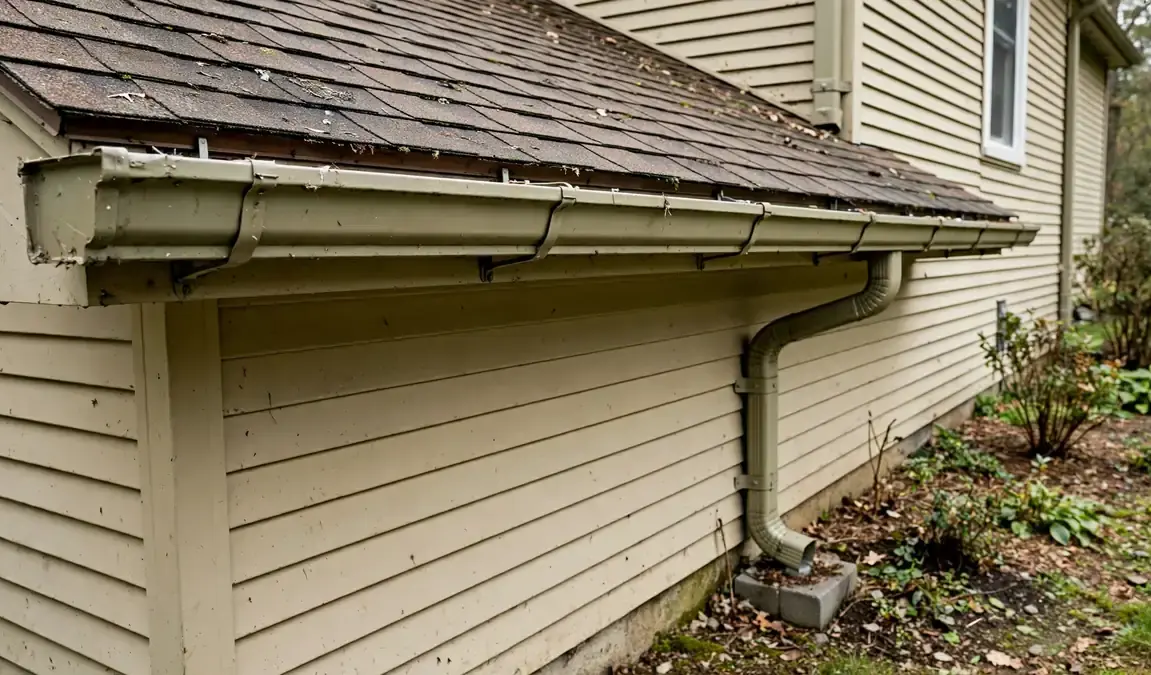
A rain gutter system is a chain of parts that all have to work together. Gutter sections carry the water, hangers hold them to the fascia, end caps stop the ends, outlets and downspouts take the water down, and elbows and extensions move it away from the house. Miss or mis-fit one piece and the whole run leaks, sags or overflows.
The main gutter parts and what each one does
The parts you will actually handle on a typical job:
- Gutter sections. The long troughs, sold in standard lengths or as seamless runs formed on site. Material is usually Aluminum, steel, Vinyl or Copper.
- Hangers and brackets. Hidden hangers, strap hangers or spike-and-ferrule sets that fix the gutter to the fascia board. Spacing matters more than the style, so check the spec sheet for your snow load and roof pitch.
- End caps. Flat or shaped plates that close the open ends of a run so water cannot pour out the side.
- Outlet (drop outlet). The cut-in fitting that connects the gutter floor to the downspout.
- Downspouts. The vertical pipes that carry water to the ground, in round or rectangular profiles.
- Elbows. Two per downspout usually, one at the top to turn the water down and one at the bottom to kick it away from the wall.
- Downspout extensions and splash blocks. The last piece that gets water past the foundation.
- Miters and corners. The inside and outside corners that join two runs at a right angle or an odd angle.
Sealant, rivets, screws and slip-joint connectors hold the joints together. Gutter guards or screens sit on top to keep leaves out.
How to plan a gutter run before you buy parts
Measure the roofline first, then work out the drainage. A common rule of thumb is one downspout for roughly every 30 to 40 feet of gutter, but check the local code and the pitch of your roof, because a steep roof in a wet climate needs more outlets than a shallow one in a dry state like Arizona.
Sketch the run on paper. Mark every corner, every end, and every place a downspout will land. That sketch becomes your parts list.
Decide on the material early, because the parts do not mix. Vinyl gutter uses Vinyl hangers and Vinyl cement. Aluminum uses Aluminum hangers and a compatible sealant. Copper needs Copper hangers and Copper rivets, and mixing metals causes corrosion.
Gutters need a slight fall toward the outlet so water moves instead of pooling. A level string line and a line level will show you the fall over the full run, and it is easier to set that slope before the hangers go up than to correct it afterward.
The tools and parts you need for the job
A basic kit covers most repairs and a short new run.
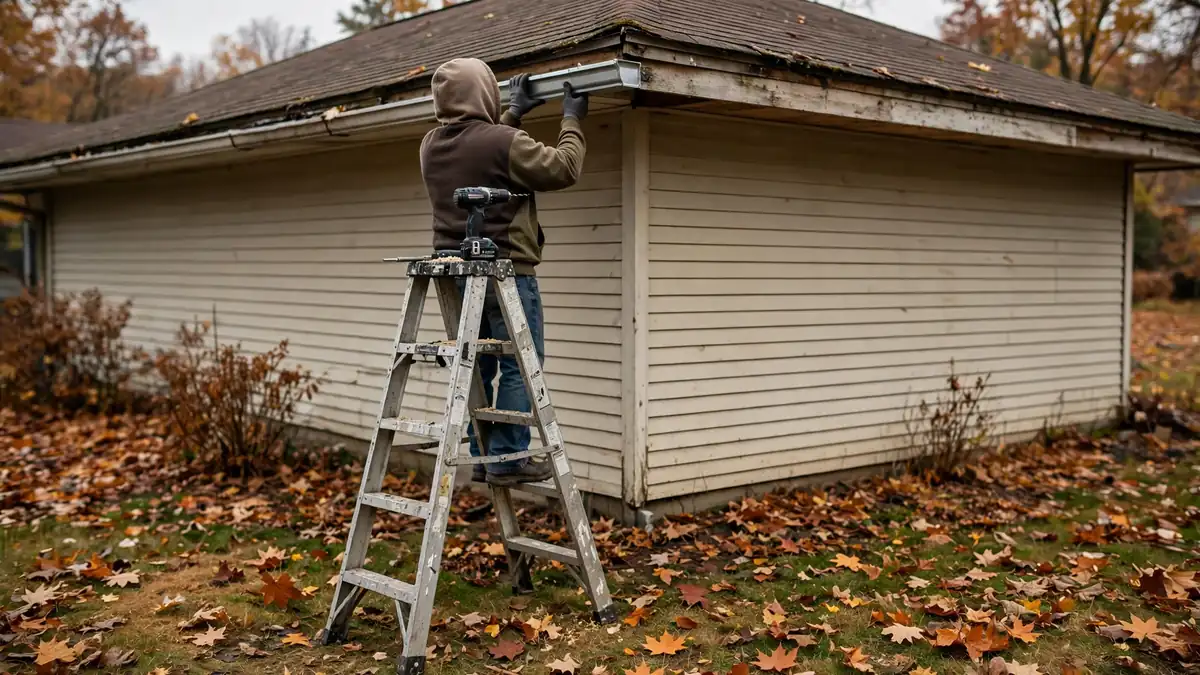
- Cordless drill with a nut driver and a drill bit
- Tin snips or a hacksaw for cutting sections
- A chalk line or string and a line level
- A stepladder and a second pair of hands
- Sealant rated for the gutter material
- Rivets or self-tapping screws
- Gloves, because cut Aluminum edges are sharp
For a full replacement, add a miter box or a miter saw with a fine blade for clean corner cuts, and a pop rivet gun for joining sections. Forming seamless gutter on site is a truck-mounted machine and a different trade.
Costs vary by region and material, so treat any figure as a rough guide. Vinyl is the cheapest per foot, Aluminum sits in the middle, and Copper is the premium choice that lasts decades. Hangers, end caps and outlets are small line items, but they add up over a long run.
Step by step: fitting a gutter section
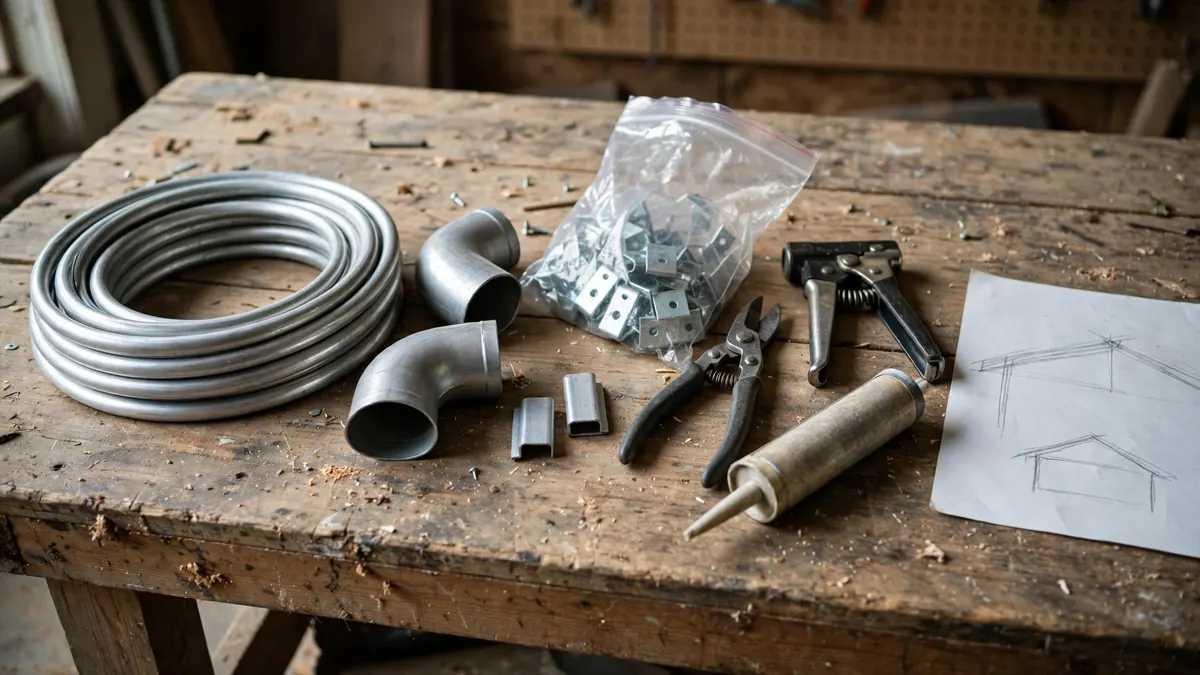
The sequence for a straightforward run on a single-story house. Two people make it much easier, one on the ladder and one handing up parts.
- Snap a chalk line along the fascia at the height you want the gutter, with the fall toward the outlet.
- Mark hanger positions along the line, following the spacing on the spec sheet for your material and climate.
- Fasten the hangers to the fascia, leaving the front clips open so the gutter can drop in.
- Cut the gutter sections to length with tin snips, and file the cut edges smooth.
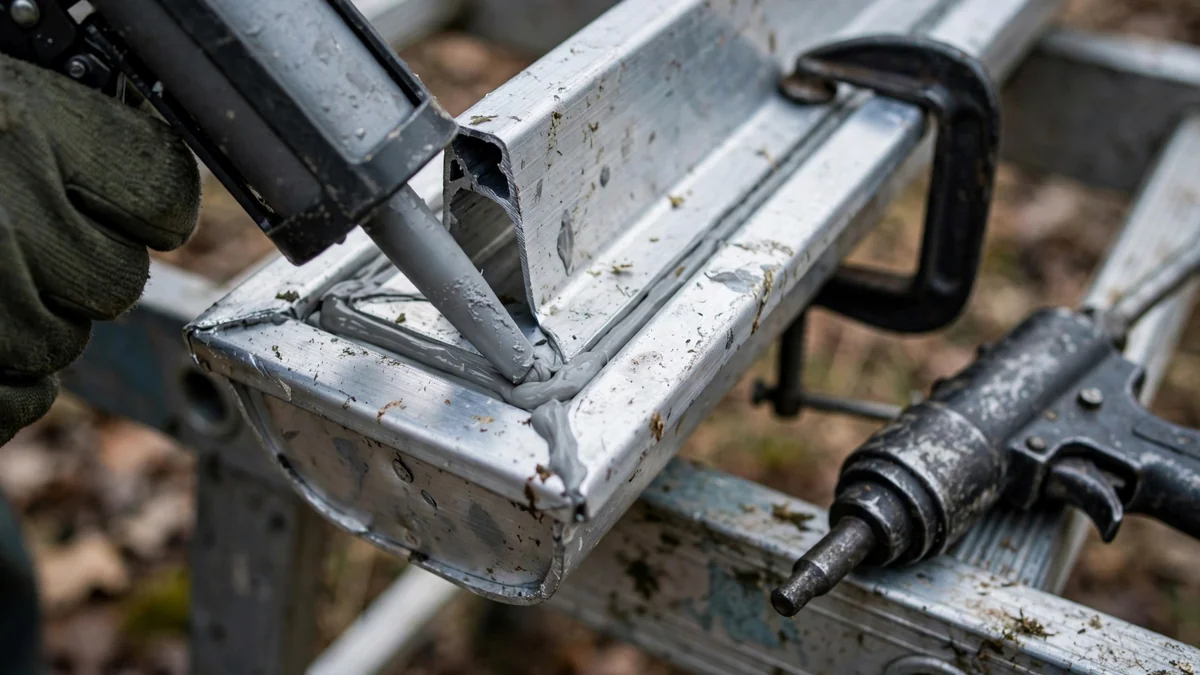
- Join sections with slip connectors and sealant, then press the run into the open hangers and close the clips.
- Fit the end caps at the closed ends and seal them, then cut the outlet hole and set the drop outlet.
- Attach the top elbow to the outlet, run the downspout down the wall with brackets, and fit the bottom elbow and extension.
Step by step: fitting a gutter section1Snap a chalk line2Mark hanger positions3Fasten the hangers4Cut the gutter sections to length5Join sections with slip connectors6Fit the end caps7Attach the top elbowThe steps from this section at a glance.
The trickiest step is the corner. A miter has to be cut at the right angle and sealed properly, or it drips for years. A bad miter is the most common leak on a new run, so read up on gutter miters and corners before you cut.
A thin bead of the right sealant, applied to a clean dry surface, holds far better than a thick smear. There is a full walkthrough on sealing gutter joints that drip if your existing run is already leaking.
Once the run is up, test it with a hose before the next storm. Run water at the high end and watch every joint, the outlet and the downspout elbows. Any drip shows up in seconds.
Common mistakes with gutter parts
Most gutter failures come down to a handful of avoidable errors.
- Wrong hanger spacing. Too few hangers and the gutter sags between them, which pools water and pulls the fasteners loose. Check the spec sheet for your snow load.
- Skipping the slope. A level gutter holds water, and standing water finds every weak seal.
- Mixing metals. Steel screws in an Aluminum gutter, or Copper hangers on a steel run, speed up corrosion. Match the metals.
- Sealing a wet joint. Sealant will not bond to a damp or dirty surface, so clean and dry the joint first.
- Forgetting the extension. A downspout that dumps water at the foundation undoes the whole job. Add an extension or splash block.
- Cutting the outlet hole too big. The drop outlet should fit snug, so measure the fitting before you cut.
Leaf guards, downspout strainers and rain barrels are parts worth adding once the basics are right, and a rundown of gutter and downspout accessories worth adding covers which ones help.
When to call a pro
Call a pro if your house is more than one story, if the roofline has complex valleys and multiple inside corners, or if the fascia board is rotten and needs replacing before any hanger goes on. Seamless gutter formed on site is also a pro job, because the machine and the truck are not something you rent for an afternoon.
Watch for the warning signs on an existing system too. Pulled hangers, rust streaks, water in the basement after rain, and gutters that overflow in a light shower all point to a problem bigger than a single part. A pro can check the whole run, re-pitch it and replace the failed sections in one visit.
On a single-story house, the parts are all available at any building supplier and the work is manageable. Check the ladder height and the condition of the fascia before you start.
Gutter Parts FAQ
What are the main parts of a rain gutter system?
The main parts are the gutter sections, hangers or brackets, end caps, the outlet, downspouts, elbows and extensions. Corners and miters join runs at angles, and sealant, rivets and screws hold the joints together.
How many downspouts do I need for my gutter run?
A common starting point is one downspout for roughly every 30 to 40 feet of gutter, but your local code and roof pitch decide the real number. A steep roof or a wet climate needs more outlets.
Can I mix gutter parts from different materials?
No, keep the metals matched. Steel fasteners in an Aluminum gutter, or Copper hangers on a steel run, cause corrosion at the joint. Vinyl parts stay with Vinyl, and Aluminum stays with Aluminum.
Why does my gutter leak at the corners?
Corner leaks usually come from a miter that was cut at the wrong angle, sealed on a dirty surface, or sealed with too much sealant that cracked as it cured. Clean and dry the joint, cut the miter to fit tight, and apply a thin bead.
How often should I check the gutter parts?
Check the system twice a year, in spring and fall, and after any big storm. Look for pulled hangers, sagging sections, loose end caps and clogged outlets.
Thank you for reading!