
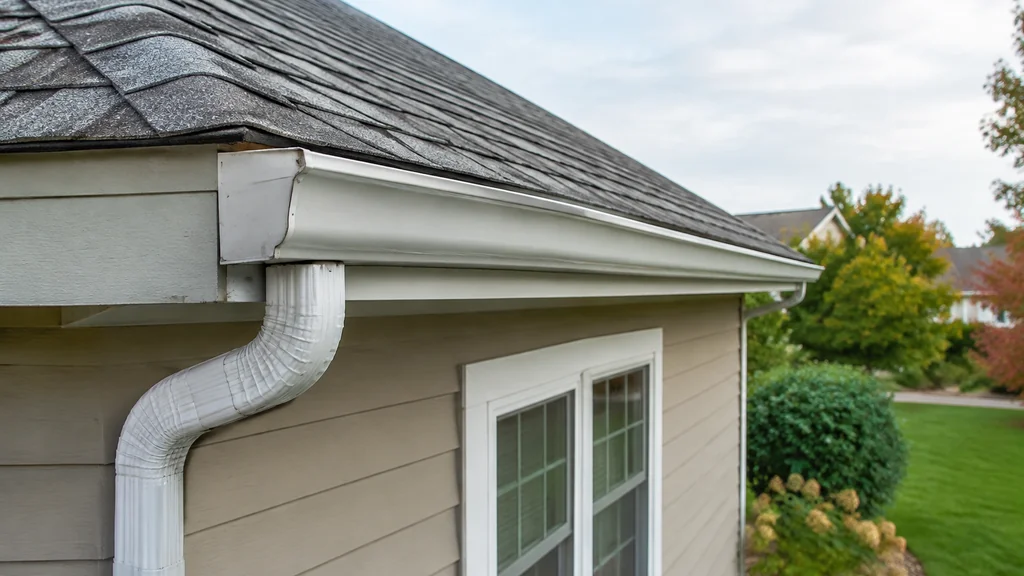
Correct Rain Gutter Slope: How Much Fall per Foot
By: John Ledford | Date Posted: October 12, 2026
Table of Contents
Rain gutter slope is the drop in height a gutter needs for water to run toward the downspout instead of sitting in the channel. The common rule of thumb is a fall of about 1/16 inch per foot of run. Many installers work closer to 1/8 inch per foot on longer runs or in heavy-rain regions. Too little pitch and water pools; too much and the gutter pulls away from the fascia or dumps water over the low end.
What the Slope Actually Does
A gutter is a shallow trough, not a level shelf. Water has to keep moving so leaves, grit, and shingle granules don’t settle and turn into a dam. That dam is where most trouble starts, and it usually shows up as a leak at a seam or a corner, or as an overflow.
The slope is measured along the run of the gutter, from the high end to the downspout. On a typical house, that run might be 30 feet on one side and 40 feet on another, and each side gets its own high point. A gutter that’s level in the middle and drops only at the ends will hold water in the middle, so the pitch has to be continuous.
The right amount depends on the length of the run, how much rain your area gets, and the size of the gutter. A short run on a small shed can get away with less fall than a long run on a two-story house. Aluminum and Galvanized Steel gutters both need a continuous pitch. If you’re unsure, check the spec sheet for the gutter profile you bought, or ask at the counter where you buy it.
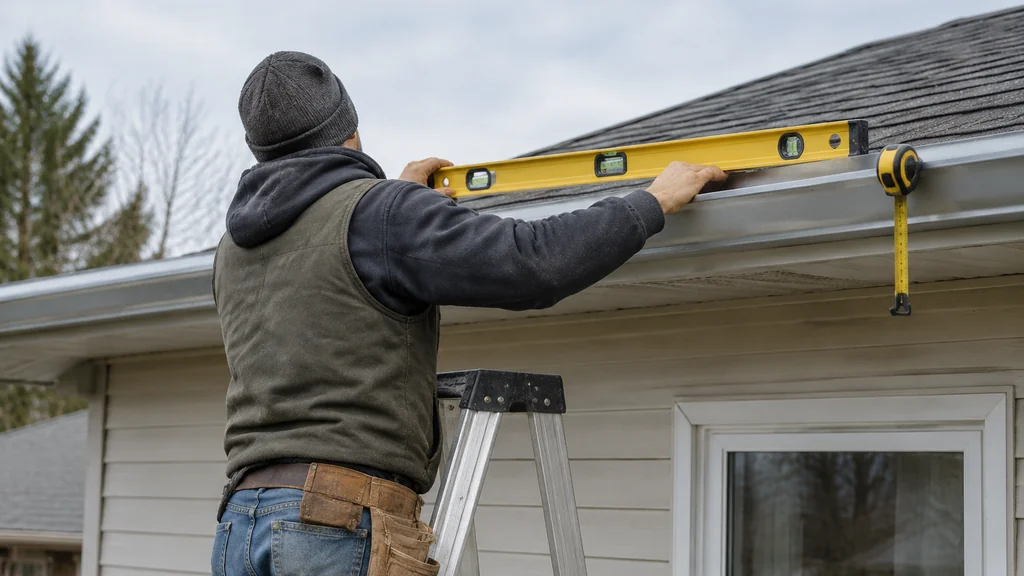
How Much Fall per Foot
The working numbers most people use are:
- 1/16 inch per foot — the minimum for a short run in a mild-rain area.
- 1/8 inch per foot — the common target for most homes, and what many installers aim for.
- 1/4 inch per foot — for long runs or heavy-rain regions, though it can look steep from the ground.
On a 40-foot run, 1/8 inch per foot works out to a total drop of 5 inches. That drop runs from the high end to the downspout. That’s the number to keep in your head when you’re setting the far end. If the fascia is level and the gutter is level, you have zero fall, and you’ll be back up the ladder after the first hard rain.
The slope runs along the gutter, not across it. The back edge should sit slightly higher than the front edge so water doesn’t run over the front lip. That’s a separate adjustment from the fall toward the downspout, and it matters just as much. Galvanized steel gutters also need this front-to-back positioning.
Tools You’ll Need
You don’t need much, and most of it is probably in the garage already.
- A 4-foot level, or a string line and a line level for long runs.
- A tape measure.
- A chalk line or a pencil.
- A drill with a nut driver or screwdriver bit.
- New hangers or brackets if the old ones are shot.
- Gloves, because the cut ends of aluminum gutters are sharp.
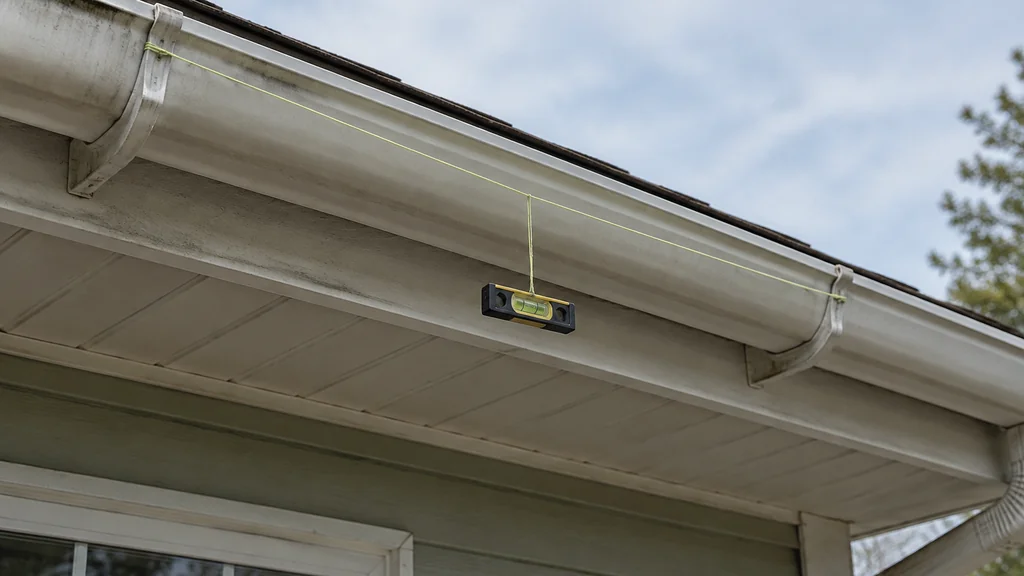
A string line is the better tool on anything over about 20 feet. Stretch it from the high end to the downspout, set the fall with a line level, and you have a straight reference the whole way. Aluminum, copper, and Galvanized Steel gutters all follow the reference line. A 4-foot level only tells you about the section it’s sitting on, so it’s easy to end up with a gutter that’s pitched in three different directions.
Setting the Slope: Step by Step
- Find the high end. That’s the end farthest from the downspout. Mark it on the fascia with a pencil.
- Find the downspout end. Measure the distance between the two points along the gutter line. That’s your run.
- Do the math. Multiply the run in feet by your chosen fall per foot. A 30-foot run at 1/8 inch per foot gives a total drop of 3.75 inches.
- Mark the low end. Measure down from your high-end mark by that total drop and mark the fascia.
- Run a string line between the two marks and check it with a line level. Adjust until the bubble sits where you want it.
- Set the hangers. Work from the high end to the low end, setting each hanger so the gutter edge follows the string. Snug them, don’t crank them down yet.
- Check the pitch again with the level before you tighten everything. A gutter that sags between hangers will hold water even if the ends are right.
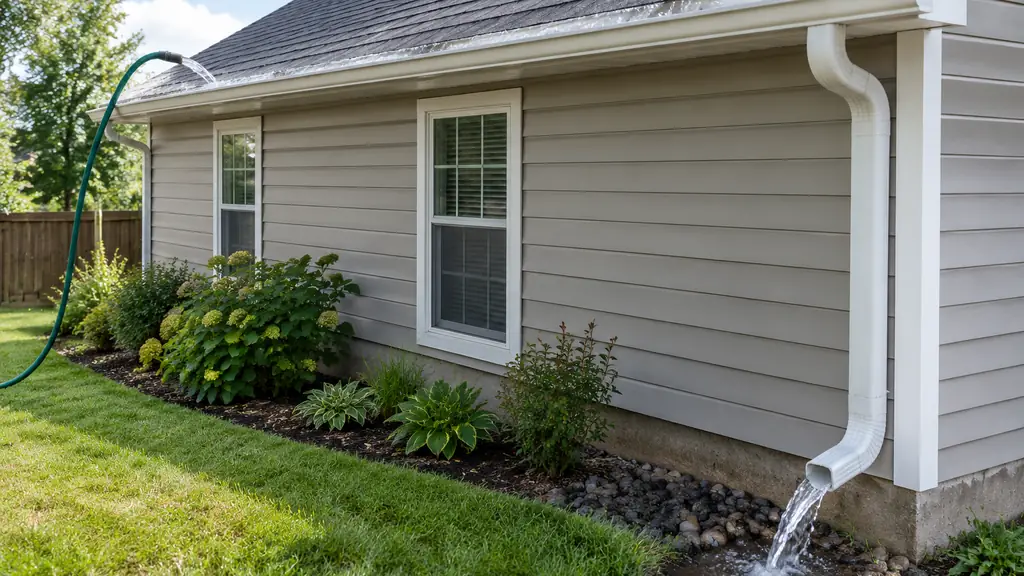
- Run water through it. A garden hose at the high end tells you more in two minutes than an hour of squinting.
Setting the Slope: Step by Step1Find the high end2Find the downspout end3Do the math4Mark the low end5Run a string line between6Set the hangers7Check the pitch again8Run water throughThe steps from this section at a glance.
If you’re replacing hangers while you’re up there, the difference between a spike and a hidden hanger matters for how well the gutter holds its line. The comparison of gutter nails, spikes and hidden hangers is worth a look before you buy hardware.
Common Mistakes
Pitching it the wrong way. Water runs downhill, so the low end has to be at the downspout. It sounds obvious until you’re on a ladder and the fascia is at an odd angle.
Too much slope. A gutter that drops hard looks wrong from the street, and on a long run it can leave a visible gap under the roofline. Stick to the range above.
Forgetting the downspout outlet. The outlet has to sit at the low point of the run. If it’s an inch uphill of the lowest point, water will sit in the gutter right next to the hole.
Sagging between hangers. Hangers spaced too far apart let the gutter dip in the middle. Check the spec sheet for spacing on your profile, and add a hanger if a section dips.
Not checking after a season. Gutters move with heat and cold, and a run that was right in the spring can be off by fall. A quick level check once a year catches it early.
If water is showing up where it shouldn’t, the location of the leak usually points to the cause. A guide to gutter leaks by location helps narrow down whether it’s a slope problem, a seam, or a hole.
When to Call a Pro
Most one-story gutters are a weekend job with a ladder and a helper. Two-story runs, steep roofs, and gutters that are already pulling away from the fascia are a different story. If the fascia itself is rotted, the hangers have nothing solid to bite into, and no amount of re-pitching will fix it. That’s a carpentry job before it’s a gutter job.
Also call someone if the run is long enough that you can’t safely reach both ends from one ladder position. Moving a ladder along a two-story wall while holding a string line is how people get hurt. The cost of a pro re-pitch is usually small compared to an emergency room visit, and if you need repairs beyond the slope, the materials and cost of leaky gutter repair are worth pricing before you decide.
Rain Gutter Slope FAQ
How much fall per foot do rain gutters need?
The common target is about 1/8 inch per foot of run, with 1/16 inch per foot as a minimum on short runs and 1/4 inch per foot on long runs or in heavy-rain areas. Check the spec sheet for your gutter profile, since the manufacturer’s recommendation is the one to follow.
Can a gutter have too much slope?
Yes. A steep pitch looks wrong from the ground and can leave a visible gap under the roofline. It also puts more strain on the hangers at the high end. Stay within the range above unless the run is unusually long.
How do I check gutter slope without climbing up?
You can’t really check it from the ground with any accuracy. A level and a tape measure on the gutter edge is the reliable method. If you’re not comfortable on a ladder, that’s a good reason to bring in someone who is.
What if the gutter is level but still drains?
A level gutter will drain slowly and leave standing water after the rain stops. That standing water is what causes rust, seam failure, and mosquito problems. Re-pitching it is usually a matter of loosening the hangers and resetting them along a string line.
Does the downspout end have to be the lowest point?
Yes. The outlet has to sit at the low end of the run, or water will pool next to it instead of draining. If the outlet is uphill of the lowest point, move the outlet or re-pitch the run so the two line up.
Thank you for reading!