
Gutter Guards on a Metal Roof: What Actually Works
By: John Ledford | Date Posted: November 2, 2026
Table of Contents
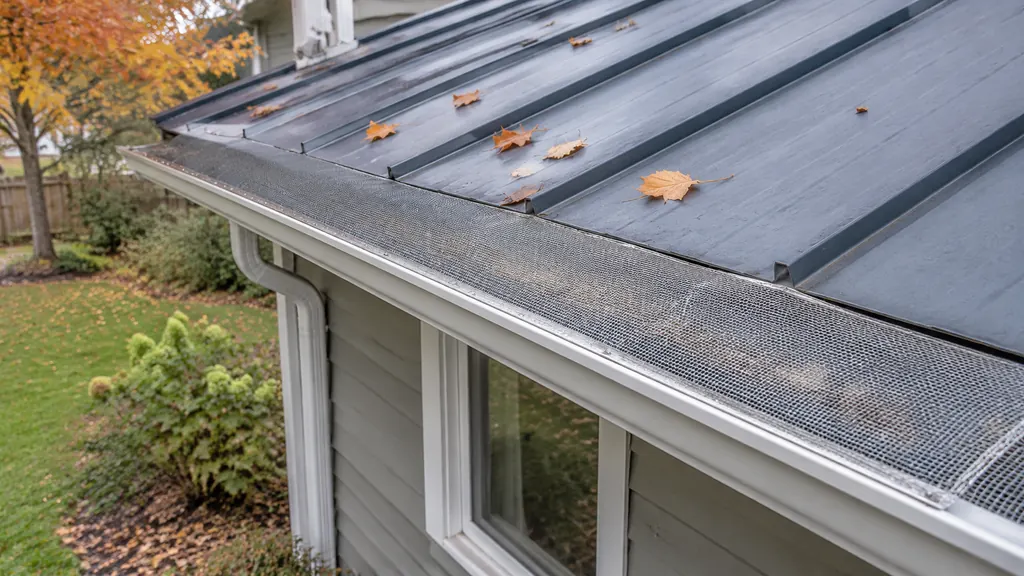
Micro-mesh panels fixed with a rigid hanger are the combination that holds up on a metal roof. The guard has to sit under the panel edge or clamp to the standing seam without drilling through the panel, and the mesh has to be fine enough to stop the debris that lands on a metal roof. Everything else is a detail you can get right in an afternoon.
Metal roofs throw a few problems at guards that shingle roofs do not. The panels expand and contract with heat, the fasteners sit on a surface that must stay watertight, and the roof pitch is often steeper than a shingle deck. Get the mounting wrong and you have created a leak path above the gutter line, which is the worst place to have one.
Why a metal roof changes the guard question
The roof surface itself is the first thing to think about. A standing-seam panel is a single sheet of metal with raised seams, and every hole you put in it is a hole in the waterproof layer. That is why clamp-on brackets that grip the seam exist, and why the screw-through guards sold for asphalt shingles are a poor match.
Extruded aluminium gutters can be rolled on site in lengths up to 30 m with internal brackets at 400 mm spacing, which tells you how much of the system is designed to move as one piece. A guard that pins the gutter to the roof fights that movement. In the UK, metal gutters with bead-stiffened fronts are governed by BS EN612:2005, and the same principle applies anywhere: the gutter profile and the guard have to be matched, not forced together.
The second thing is debris. Metal roofs shed differently from shingles. Asphalt granules wash into gutters and pile up, while a metal panel releases leaves and needles in bigger slugs. That changes which guard type makes sense, and it is why the mesh grade matters more than the frame.
What actually works on a metal roof
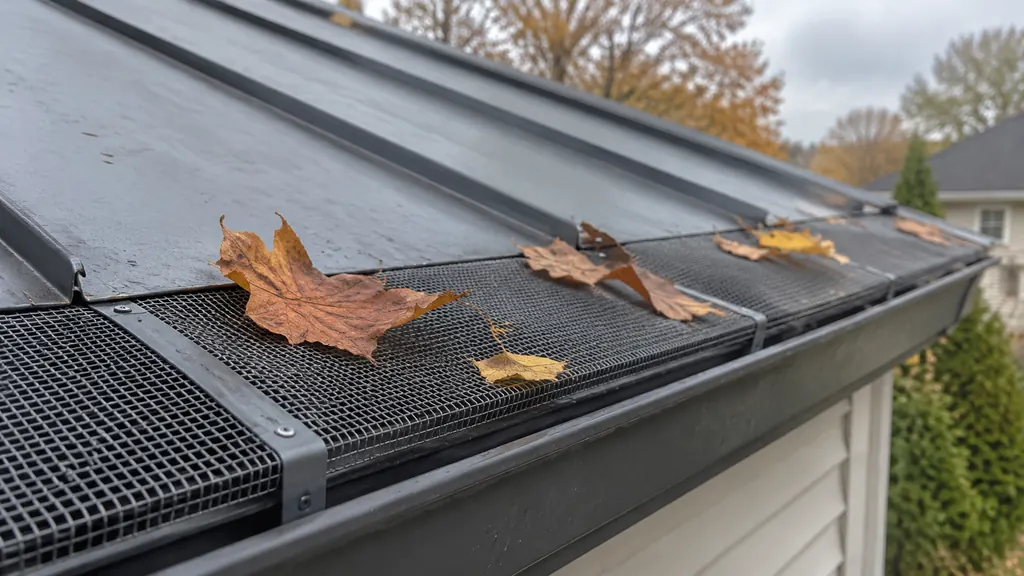
Micro-mesh is the guard type that earns its place on a metal roof. The mesh is fine enough to stop the small stuff that a wide slot lets through, and it sheds water fast enough that the gutter still does its job in a downpour.
Bob Vila’s testers ran Waterlock micro mesh through 2 weeks of testing with several heavy rains, and it stopped leaves, twigs, and asphalt granules. That is the standard to hold any guard against. If a product cannot keep granules out, it will not keep moss and grit off a metal roof either.
Stainless micro-mesh is the version I would fit. It resists rust at the cut edges and holds its shape when you lean a ladder against the gutter. Aluminium mesh is lighter and cheaper, and it dents. Plastic mesh is the one to leave on the shelf.
The frame matters as much as the mesh. A rigid aluminium or steel spine keeps the panel flat across the gutter mouth so it does not sag under snow or a falling branch. A floppy panel lifts at the edges and lets debris in underneath, which defeats the whole exercise.
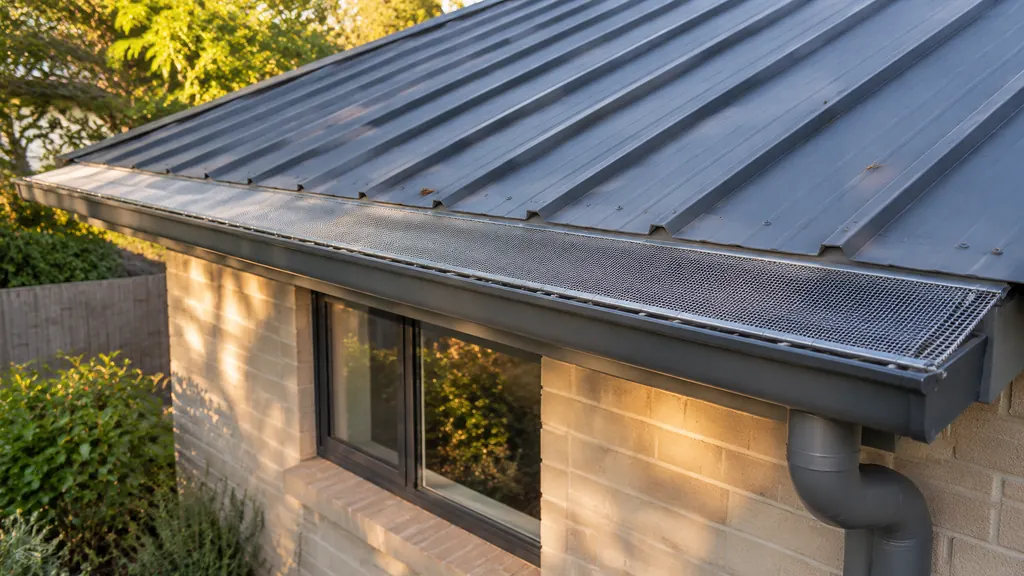
Powder-coated frames give you colour choices. Waterlock offers 14 colour options for the exposed lip of its micro-mesh guards, which matters on a metal roof where the guard line is visible from the ground. A guard that matches the fascia disappears. A shiny silver one on a dark roof does not.
Matching the guard to the panel profile
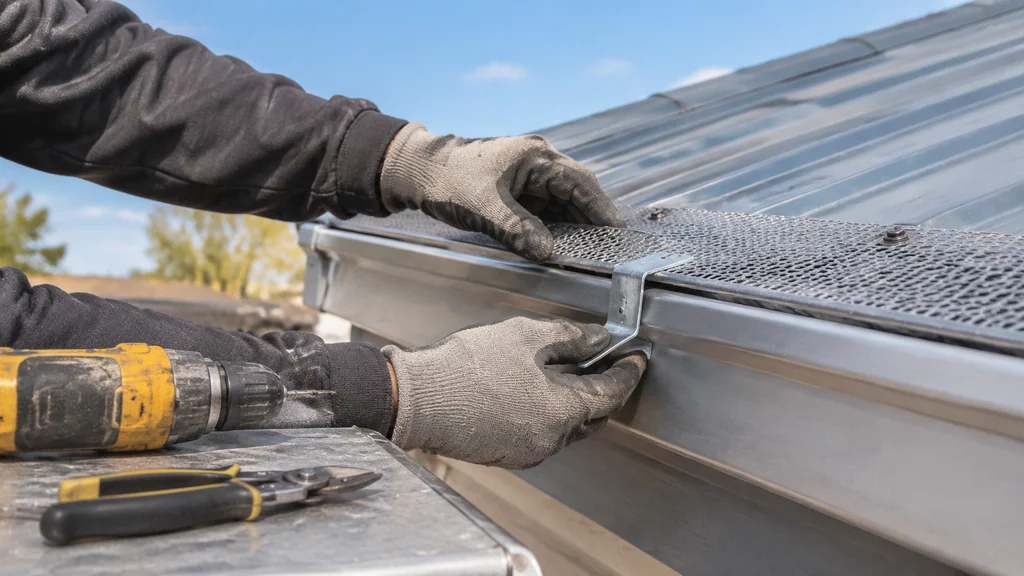
Standing seam is the easiest metal roof to guard, because the seam gives you a solid mounting point. A clamp bracket wraps the seam without piercing it, and the guard hangs from that clamp. The clamp has to be sized to the seam, so measure the seam height and width before you order. Check the spec sheet for the clamp range.
Corrugated and ribbed panels are harder. The profile is wavy, so a flat guard bridges the high points and leaves gaps at the low ones. The fix is a guard with a flexible spine or a profile-specific bracket that follows the ribs. Some manufacturers sell a corrugated adapter. If yours does not, a flat panel will rattle and leak debris at every trough.
Exposed-fastener panels with screws through the metal are the worst case. The screw heads sit proud of the surface and the guard cannot sit flat. You can still fit a guard, but it needs a standoff bracket that clears the fasteners, and you should check that the bracket does not trap water against a screw head.
Metal shingle roofs fall somewhere in between. They behave like a shingle roof for mounting but shed like metal. A hanger that hooks under the course above the gutter works here, provided the hook is thin enough not to lift the shingle.
The installation, step by step
This is a half-day job on a single-storey roof and a full day on a two-storey one, mostly because of the ladder work. I would not do it alone above the first floor. Get a second pair of hands for lifting panels and for passing tools.
- Clear the gutters completely and flush the downpipes. A guard over a gutter full of debris just hides the problem.
- Check the fascia and the panel edge for rot, loose fixings or lifted sealant, and repair before you cover anything.
- Measure the seam spacing or the rib pitch, and the gutter width, then order guards cut to length with the right brackets.
- Fit the first bracket at one end, set the guard in place, and check the fall with a level before you fix the rest.
- Work along the run, clipping or clamping brackets at the spacing the manufacturer specifies, and keep the panel joints tight.
- Cut the last panel to length with tin snips or a fine-tooth blade, and file the cut edge so it does not rust or catch a hand.
- Run water from a hose along the full length and watch the downpipe outlet. Any water running over the front lip means the mesh is overloaded or the fall is wrong.
The slipperiest step is the first bracket. Get that one level and square and the rest of the run follows. Get it wrong and you fight the whole length. Mark the bracket position on the fascia with a pencil before you drill or clamp anything.
Tools and materials
You do not need much. A tape measure, a spirit level, a cordless drill with a driver bit, tin snips, a file, and a ladder with a standoff. Add a pair of gloves, because the cut edges of mesh and flashing are sharp.
For fasteners, match the driver to the screw. Phillips heads cam out under load, Torx holds better on a ladder, and hex-head self-drillers are the usual choice for metal brackets. Stainless screws cost more and last longer on a metal roof, where galvanic corrosion between dissimilar metals is a real risk.
If you are replacing the gutter at the same time, look at the guard and the gutter as one system. A deep gutter with a wide mouth takes a different guard from a narrow half-round. The review of mesh, micro-mesh, foam and reverse curve profiles is a good place to compare how each type behaves before you buy.
What it costs and what you get back
Guard prices vary widely by material and mesh grade. Check the label and get two or three quotes for the length you need. Stainless micro-mesh sits at the top of the range, aluminium mesh in the middle, and plastic at the bottom.
The payback is in cleaning time. Gutters with guards typically need a thorough cleaning only once every 2 years, according to Bob Vila, which is a real change if you are up a ladder twice a year now. On a metal roof, where a blocked gutter can back water under the panel edge, that interval is worth having.
Set the cost against a call-out. If you pay someone to clear the gutters twice a year, the guard pays for itself in a few seasons. If you do it yourself, you are buying back a Saturday. Either way, price the guard per metre and add the brackets, because the brackets are where cheap kits cut corners.
Mistakes that cost you on a metal roof
The first mistake is drilling through the panel to fix a guard. Every screw is a potential leak, and on a standing seam you have a perfectly good clamp point that needs no hole at all. If a guard only comes with screws, it is the wrong guard for this roof.
The second is buying a guard with a coarse slot and expecting it to handle needles. Pine needles and small seed pods pass straight through a wide opening. If you have conifers near the roof, read the guide to guards for pine needles before you order, because mesh grade decides whether the guard works at all.
The third is fitting the guard tight to the panel with no gap for expansion. Metal moves with temperature, and a guard pinned hard against the panel buckles or pulls its fixings. Leave the movement allowance the manufacturer specifies.
The fourth is ignoring the downpipe. A guard that keeps leaves out of the gutter still lets them collect at the outlet. Fit a leaf strainer at the downpipe mouth and check it after the first big storm.
The fifth is fitting a guard over a gutter that already overflows. If water runs over the front lip in a heavy rain now, the fall is wrong or the gutter is undersized. A guard will not fix that, and it can make it worse by slowing the water.
When to call a pro
Call a roofer if your metal roof is above the first floor, if the panels are old and the seams are loose, or if you cannot identify the panel profile. A roofer will know the clamp that fits and will not put a ladder against a panel that dents.
Call a gutter specialist if the gutter itself is failing. Sagging brackets, leaking joints and rust holes are gutter problems, not guard problems, and a guard fitted over a failing gutter wastes the money. The independent testing round-up of consumer reports on gutter guards is useful here, because it separates guard performance from gutter condition.
Call an electrician if the guard run crosses under overhead cables or near a service mast. Do not work around power lines on a ladder, whatever the guard costs.
Gutter Guards on a Metal Roof FAQ
Do gutter guards work on a metal roof?
Yes, when the guard is clamped to the standing seam or hooked under the panel edge without piercing the metal. Micro-mesh panels with a rigid spine are the type that holds up, because they stop leaves, twigs and granules and still pass heavy rain.
Can you screw gutter guards into a metal roof?
You can, but you should not. Every screw is a hole in the waterproof layer, and a standing seam gives you a clamp point that needs no penetration. Use seam clamps or under-panel hangers and keep the fasteners out of the panel.
How often do gutters with guards need cleaning?
A thorough cleaning once every 2 years is typically enough, according to Bob Vila. Check the downpipe strainer and the guard surface after autumn leaf fall, and clear any build-up at the outlets before winter.
What is the best guard for pine needles on a metal roof?
A fine stainless micro-mesh is the grade that stops pine needles, because the openings are small enough that the needles cannot pass through. Wide-slot and brush guards let needles straight into the gutter, where they mat and block the outlet.
Does a gutter guard void a metal roof warranty?
It can if the guard is fixed with screws through the panel or traps water against the metal. Check the roof manufacturer’s terms before you fit anything, and use a clamp-on system that leaves the panel surface untouched.
Thank you for reading!