
K-Style vs Half-Round Gutters: Which Profile to Choose
By: John Ledford | Date Posted: November 9, 2026
Table of Contents
The right pick comes down to your fascia, your roof edge, and how much rain your region throws at the house.
What Actually Separates the Two Profiles
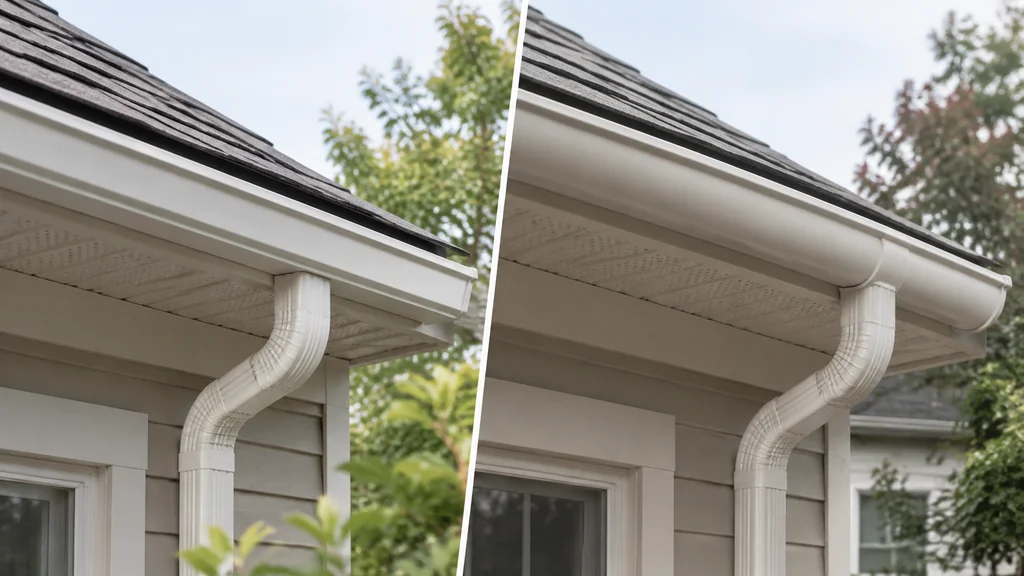
That flat back is the whole point. It tucks tight against the wood, hides the hanger hardware, and gives the run a finished look from the street.
Half-round gutters are exactly what the name says, a half cylinder open at the top. They hang from hangers that wrap under the curve or from a fascia bracket, and on old houses they often sit on a crown molding or a decorative band. The look is traditional because it is traditional.
If you are replacing like for like, that rarely matters. If you are sizing from scratch, it does.
How to Size the Run Before You Pick a Profile
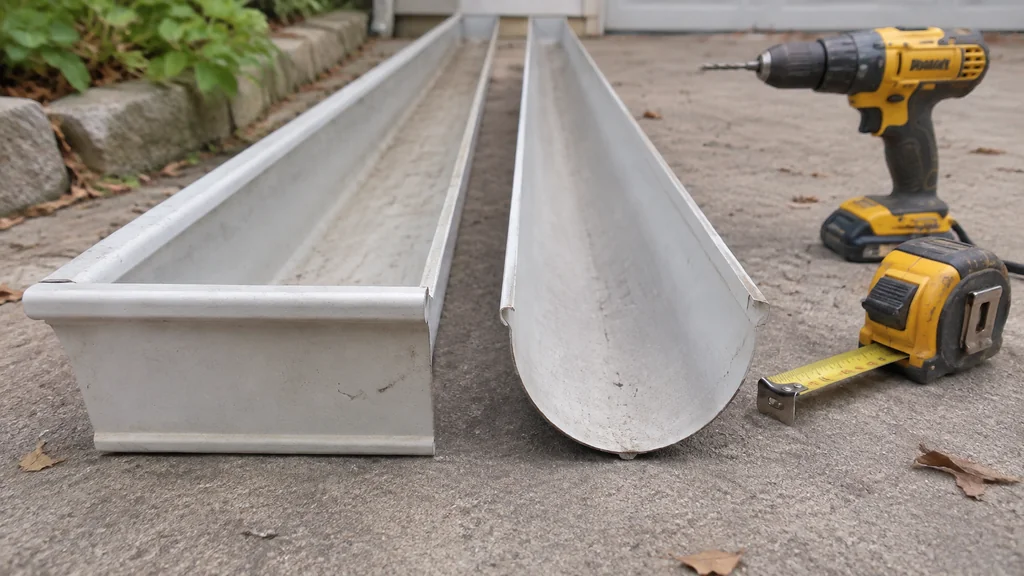
Gutter sizing is arithmetic, and the arithmetic starts with rainfall intensity. That single number drives the whole calculation, and it is not the same everywhere.
The same source shows why. More annual rain does not automatically mean a harder design storm. Intensity over a short burst is what overwhelms a gutter, and local climate determines that intensity more than the yearly total.
Work out the roof area that drains to each run, multiply by the design rainfall intensity for your area, and compare against the capacity the profile gives you at the slope you can achieve. Your local code or the manufacturer’s spec sheet carries the capacity figures. Do not guess them.
Here is the order I work in:
- Measure the roof footprint that drains to each gutter run, including any slope factor for pitched roofs.
- Find the design rainfall intensity your local rules or building department use.
- Multiply area by intensity to get the flow the run must carry.
- Check the capacity of each candidate profile at your planned slope, from the maker’s spec sheet.
- Count the downspouts.
- Confirm the fascia is sound and flat enough for the hangers you plan to use.
- Only then pick the profile and buy the fittings.
K-Style Gutters: Where They Earn Their Place
Fittings, corners, end caps, and outlets are available for the system, which matters when you are one elbow short on a Sunday. Measure the gutter width and outlet size before shopping, because K-style components are shaped to match the profile. A replacement end cap that looks close can still leak if its contour or seal does not match the channel.
K-style gutters also offer a broad front face for colour coordination with fascia, soffit, and roof trim. The squared profile can look understated on a newer house, especially when the gutter is close to the colour of the fascia. Its internal corners still need careful cleaning, since debris can sit where the bottom meets the side walls.
The profile also plays well with gutter guards. If you are adding mesh or a screen, the flat front gives the guard something to grip. The guide to gutter guards on a metal roof covers hanger and clip choices.
The weak spot is the shape itself. Cleaning a K-style run means scraping those corners along with scooping leaves. On a tall house, that is a job you will pay for.
Half-Round Gutters: The Case for the Curve
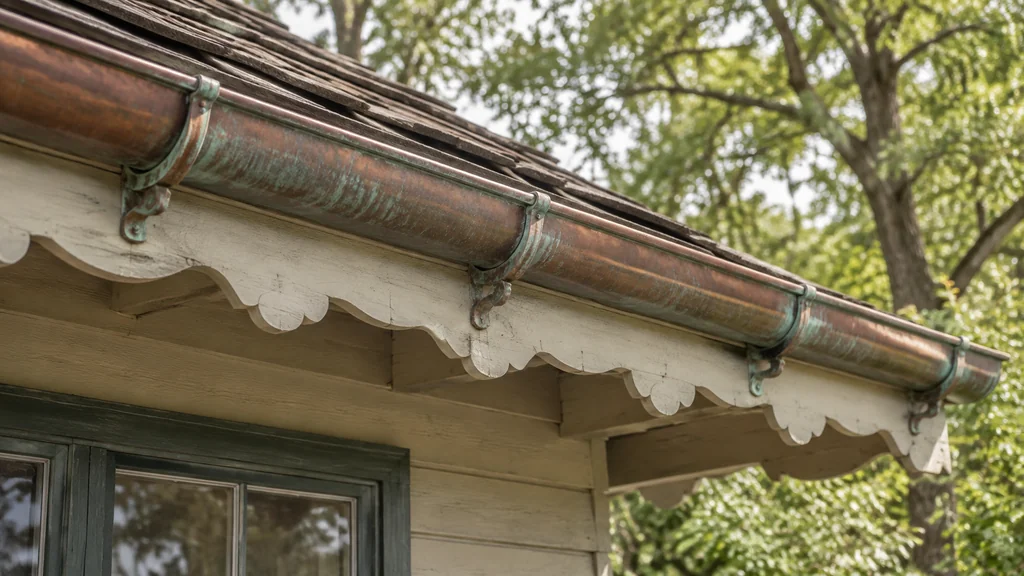
If you are restoring an older home, half-round keeps the elevation consistent with its original design. Its curved face pairs naturally with exposed rafter tails, decorative fascia, and older roof lines. The profile also leaves more of the supporting hardware visible, so the brackets become part of the exterior detail.
The trade-offs are real. Hangers are more visible, whether they are wrap-around straps or fascia brackets. That visibility can help during inspection because you can see the fastening points, but it also means the hardware needs to suit the house. Stainless steel and Aluminum brackets are common choices where the surrounding gutter material and finish allow them.
Material choice runs wider in half-round, too. Copper, Aluminum, and galvanized steel are available in this profile. Copper changes colour as it develops a patina, while Aluminum keeps the weight down and can be ordered in finishes that coordinate with the trim. Galvanized steel provides a rigid run but needs compatible fittings and attention to exposed cut edges.
Materials, Hangers, and the Details That Decide
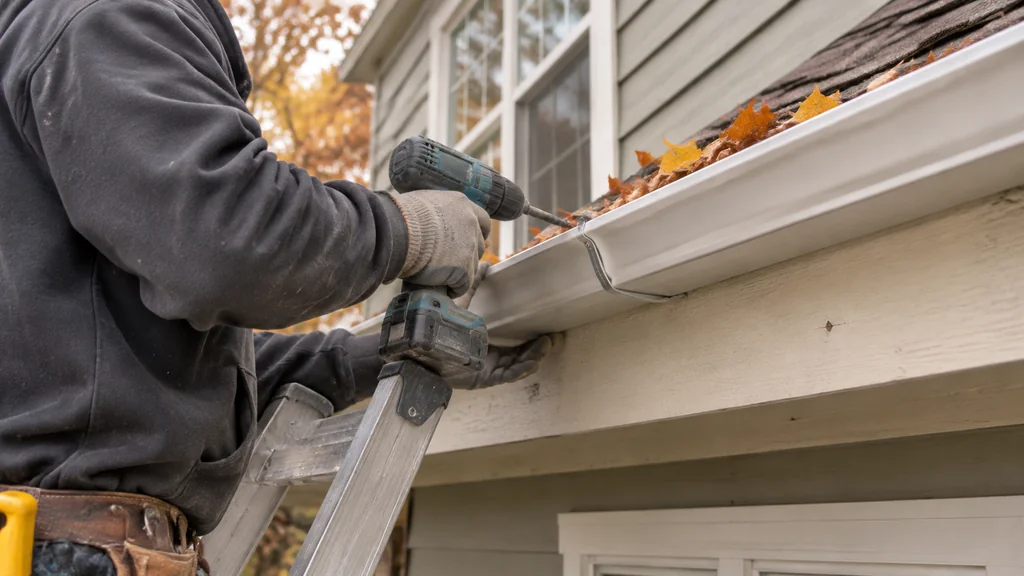
Hanger spacing is where installations fail. Check the fascia with a screwdriver before you buy anything. If it crumbles, fix the wood first.
Seams and outlets are the other failure point. On a long run, expansion is a factor too. Metal moves with temperature, and a run pinned tight at both ends will buckle at a seam. Slip joints and sealant made for the metal handle it. Clean each joint before sealing, and support the outlet so its weight does not pull the surrounding gutter out of line.
Different materials also need compatible fittings. Copper should be joined with components intended for Copper, while Aluminum and galvanized steel need sealants and fasteners that will not accelerate corrosion. Keep cut edges covered where the finish has been removed, and allow the sealant to cure before testing the run with a hose.
Downspout screens and guards are worth planning at the same time. The piece on stopping nests in downspouts walks through the fit. It is cheaper to add that at installation than to fish a nest out in spring.
Cost, Time, and the Honest Comparison
If you are paying a pro, the install involves more care around the fittings, hangers, and seams. Half-round systems can require more attention to bracket alignment because the channel must sit securely in the curved supports. K-style systems often use hidden hangers, which speed up the finished appearance but still depend on accurate fixing into the fascia.
Time is the hidden cost. My advice is to practice on a short back run before you tackle the front of the house. Lay out the outlets, corners, and downspouts on the ground first. Mark the high point and outlet point on the fascia, then set the fall between them. This reduces the chance of cutting a section before the complete route is clear.
A short test section also reveals whether the chosen hanger reaches solid wood and whether the roof edge leaves enough room for the gutter. Check the clearance from the drip edge, shingles, or metal roofing before fastening the full run. Water should enter the channel cleanly without running behind it.
If the fascia is rotten, the roof edge is failing, or the run is more than one story up, call a pro.
Mistakes I See on Both Profiles
The first mistake is picking the profile before sizing the run. A beautiful half-round that overflows in a downpour is a failed gutter, and a K-style that is too narrow for the roof area does the same. Do the flow arithmetic first.
The second is hanging new gutter on old fascia. The gutter is only as straight as the board behind it. Replace soft sections, prime the cuts, and set the hangers into solid wood.
The third is skipping the slope. Gutters need to fall toward the outlet. Check it with a level before you crimp the last hanger.
The fourth is ignoring the downspouts. A big gutter feeding one small outlet still overflows at the outlet.
The fifth is forgetting the guards until after the leaves arrive. Plan the guard with the gutter, especially on a half-round under trees. If ice dams are a worry in your climate, the piece on whether gutter guards cause or prevent ice dams is worth reading before winter.
FAQ
Do K-style gutters hold more water than half-round?
K-style gutters generally hold more water than half-round gutters of comparable nominal width, but the actual capacity depends on the profile, slope, outlet arrangement, and design rainfall intensity. Check the maker’s spec sheet for the capacity at your planned slope.
Can I put a half-round gutter on a modern house?
Yes, half-round gutters can be fitted to a modern house when the brackets, fascia, roof edge, and colour suit the design. Match the profile to the architecture and confirm that the available fittings work with the roof edge.
Which profile is better on a metal roof?
Both profiles can work on a metal roof when the hangers and clips suit the roof edge. K-style can work with the right clips, but the fit is fussier. Read the roof maker’s guidance before you buy hangers.
How do I know what size gutter I need?
Size the run from the roof area that drains to it and the design rainfall intensity for your area, then compare against the profile’s capacity at your slope. Your local rules may differ, so check them.
Is half-round harder to clean?
Half-round gutters usually have fewer internal corners, so loose debris can be easier to scoop out, although access and guard design still affect the job. K-style gutters collect debris in their corners, while guards can reduce how often either profile needs cleaning.
Thank you for reading!